This page has affiliate links. If you click and buy something, EitM might earn a small commission, at no extra cost to you, the reader. As always, thanks for reading.
Dieng Plateau: Temples and Rich Culture in Central Java
High in the hills of Central Java lurks the Dieng Plateau. This is a holy place marked by temples and places of worship, which gives a glimpse into a time long ago when Java still took shape.
The plateau forms the base of the Dieng Volcanic Complex. There, the fertile earth sits and rests, and it resides in stillness. And walking upon this mountainous land stirs the senses and creates a sense of grand old age. Further research reveals that Dieng’s name derives from old Javanese: ‘di’, to mean ‘place’, and ‘hiyang’, to mean ‘ancestors’ or ‘gods’.
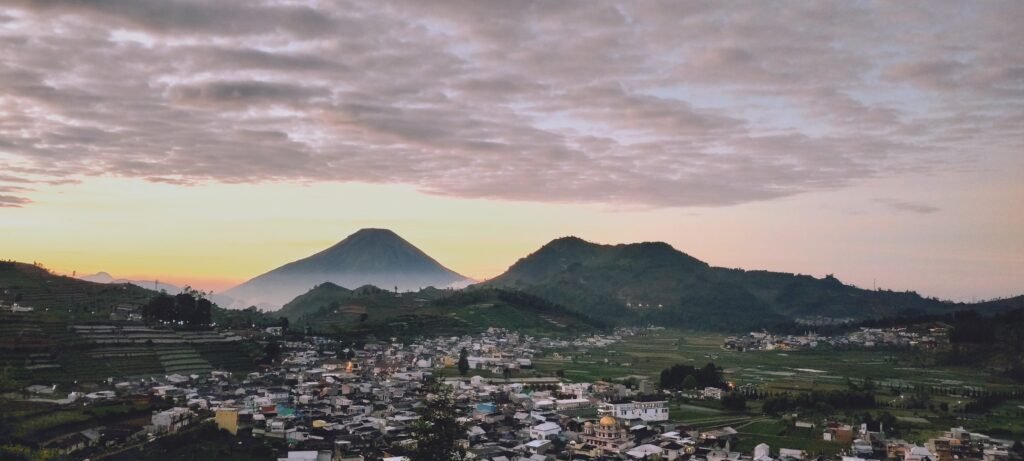
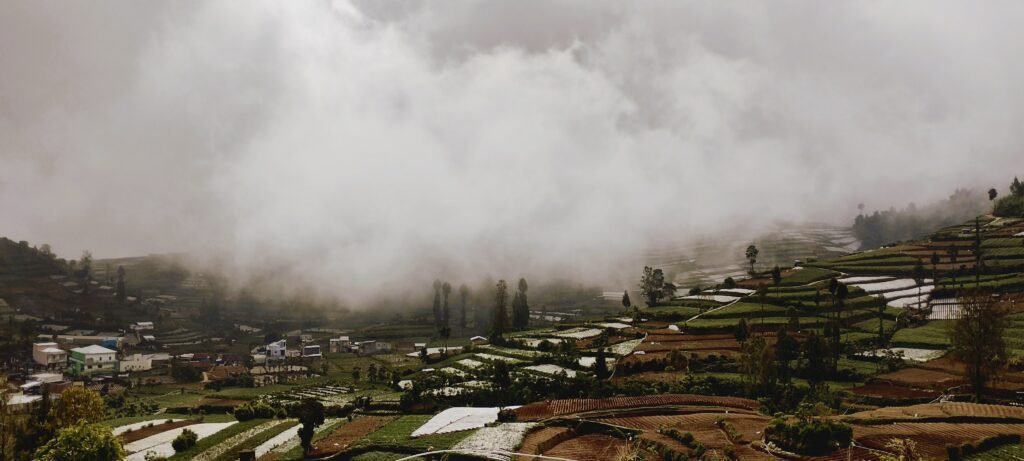
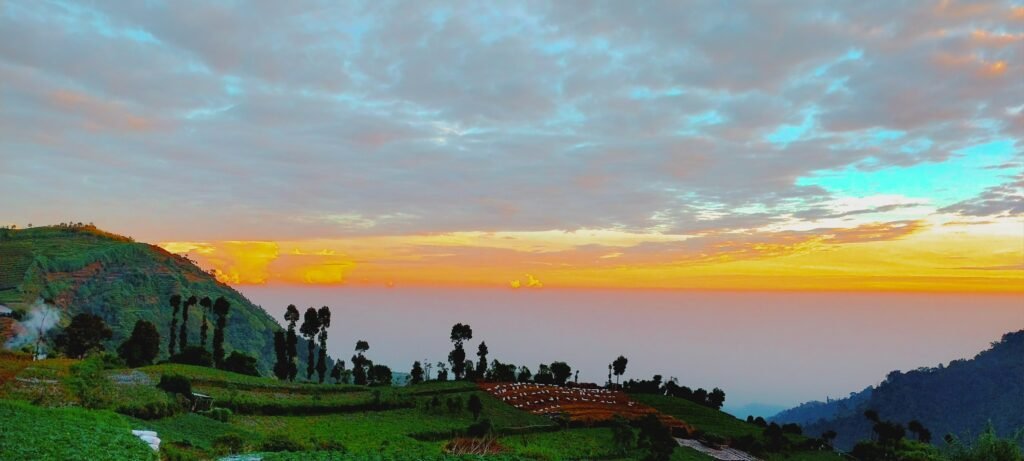
The Dieng Plateau is the place where, some say, gods and ancestors reside. And they do so on a land that sits above the clouds, where mountains and peaks rise from a sea of mist, and the land is amongst the greenest in the whole of Indonesia. A magical, ethereal throb seems to have settled over Dieng.
Such distortion creates a new kind of clarity. It lets the mind pick up on things that it may not otherwise glimpse. Small wonder, then, that early Hindus deemed Dieng sacred. They showed their reverence by building hundreds of temples on the plateau and further afield.
Most arrive in Dieng from Wonosobo, a pretty town nestled amongst tea plantations and rice fields. Wonosobo sits on the road to Dieng. It benefits from the same fresh greenness that is a common trait of this region, and which becomes more pronounced the closer one climbs to the plateau, which is roughly 9 miles in length and 4 miles wide.
Ascent to the plateau
And as the road rises and bends, the air thins and the temperature drops. Many can see their breath form as a fine vapour in the air, through which they can see valleys and yet more patches of green. Here, the air is crisp and fresh, and it feels clean. The journey to Dieng elicits the same pleasing jolt to the system as stepping into a frosty morning.
A fine time, then, to meet Ibu on the side of the road, perhaps along Jl. Telaga Warna. In Indonesia, ‘Ibu’ is a sign of respect and politeness towards adult women. It translates ‘mother’, ‘miss’ or ‘madam’. An outsider who knows how and when to use the term shows that they understand at least a little bit of how life works. And many Ibus plough the streets of Dieng, most sporting colourful blouses. Some also carry baskets of food from which they sell all the things to sate a hungry visitor: satay, noodles, rice, tofu, vegetables, eggs and so on.
These food sellers display the same degree of casual expertise in their craft that so many in Indonesia possess. Their skills confound all those who lack the gift for cooking. Having found a customer, Ibu crouches. Then, by way of pointing and polite inquiry, she pieces together a meal from the many layers of her basket.
As a final step, she may open up an extra compartment. Ibu pulls from here the meal’s last ingredients. These she uses to whip up a sambal or peanut sauce. And she does so in a matter of seconds, creating something that tastes as fine as can be found in any high-end restaurant. And as Ibu goes on her way, trailing a friendly farewell in her wake, she leaves behind a customer dazed by the humble mastery they have just seen.
Majestic expanse
Looking hard enough, it is possible to see the outlines of a trio of gunungs that dominate the caldera: Prau, Sikunir and Sundoro. The closest to Dieng is Prau. These three mountains sit with the same majesty as others of their type in Java, and they receive many visitors from Dieng. Each day, walkers traipse to pretty viewpoints on the peaks where they camp out and watch the sun rise, some hoping that intrusive thoughts don’t ruin the promise of a new start.
Those who walk on one of the elevated outskirts around the centre of Dieng will hear a pious din. Five times a day, they can listen to calls to prayer from the area’s many mosques. These calls echo and collide with one another to form a new sound that floats over the valley. On their way, the calls merge with others of the same kind and amplify the messages carried within.
Read More: Visit Pamekasan: Madura’s Rich History and Unique Culture
It is a moving experience, even for the secular listener. Some visitors report that at these times, they watch their breath form and evaporate in the cold air, and wonder if their spirit has left their body in search of a more holy purpose.
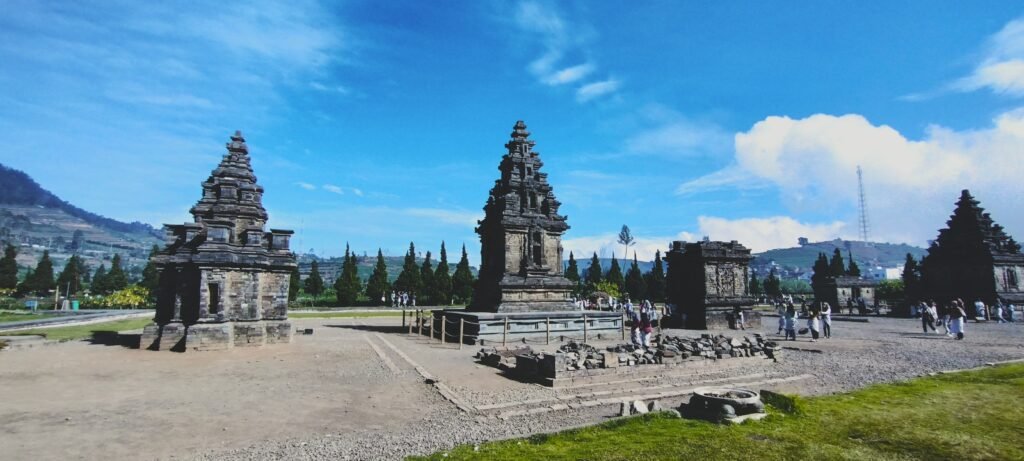
And as they look around, the visitor soon finds that they are in the presence of some of Indonesia’s oldest religious structures. Dieng is a lofty, ethereal place. It sits 2,000 metres above sea level, and scattered around its recesses are the remains – some complete, others only as memory – of many temples. Experts claim that the site once housed as many as 400 of these structures. However, the passage of time has meant that only eight have survived.
A brief history of Dieng
History shows that Dieng’s temples, by way of their South Indian architectural style, date back as early as the sixth century. Other signs point to the Mataram Kingdom of the eighth century. Either way, experts have claimed that the temples are the oldest known standing stone structures in Central Java.
The earliest recorded temple was built around 750CE and shows Dieng’s Hindu roots. The monument honours the god Shiva, while close by, other stone buildings pay tribute to Vishnu and other Hindu deities. Dieng was chosen to host holy rituals because of its altitude and unspoiled ambience. One suspects the place’s distance from the noise and hot air closer to sea level made it an ideal place to commune with higher beings.
Dieng’s still landscape and high altitudes lend it a sacred air. And its peaks give credence to the Javanese tradition that mountains are the points where earth and heaven meet. These same traditions once named Dieng as a cosmic axis that links the world with faith and nature. Such a notion chimes with Hindu cosmology, which speaks of many holy places. According to Hinduism, the god Shiva lives in a constant state of meditation and requires quiet to keep his focus. His home is the holy mountain of Kailash in Tibet.
True belief
Worship of Shiva extended far. And with Dieng considered a holy place in its own right, that aligns with the stillness favoured by Shiva, the god who lives on a mountain, and the Hindu traditions of Central Java, it makes sense that worship of Shiva took hold on the plateau.
Many of the temples bear the signs of Shiva worship, in the form of markings, statues, yoni and phalluses. The complex takes its cues from Indian temples, with plans based upon Hindu scriptures. But this is a Javanese site. It was formed from volcanic eruptions and carries the whiff of sulphur clouds from aged craters. A walk around the area brings to mind an elemental place of worship, and it is Java, and nowhere else, that one can see from the heights of Dieng.
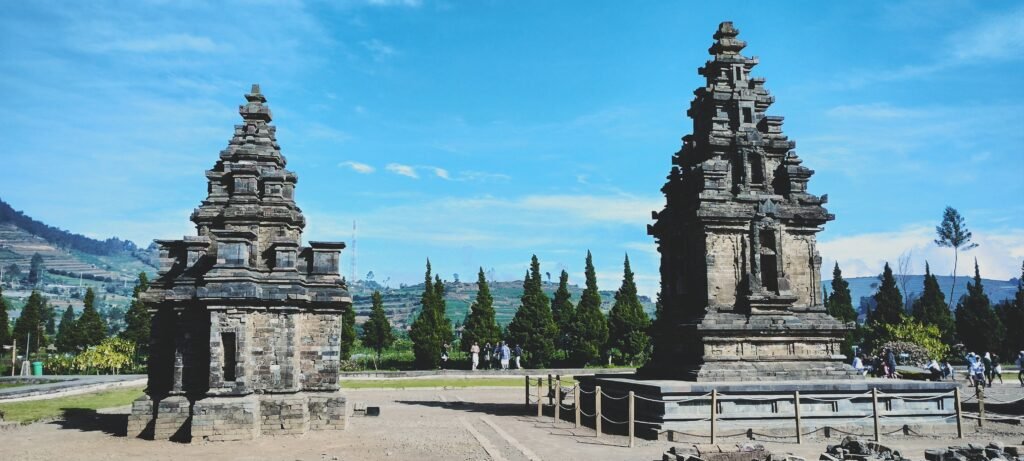
The temples of Dieng bear the hallmarks of a North Central Javanese style. These small structures have simple designs. Plain carvings mark their sides, with many prominent Kala-Makara sea creature motifs and scenes from Hindu mythology. More to the point, the temples tend to have no clear order, often arranged in irregular groups. The Gedong Songo temples near Semarang share the same less-ordered look.
This modesty stands in contrast to the immense, splendid southern Central Javanese temples. Borobudur, designed around a Buddhist mandala, and Prambanan both blow the mind with their high spires, monumental scale and intricate reliefs.
Ancient knowledge
Data shows that the Sanjaya Dynasty built the temples of Dieng in the seventh century. Whoever built them sought to mimic the look of Prambanan, on a smaller scale. History has lost the temples’ original names, their history and the king who ordered their construction. However, the date of the temples’ building links Dieng to the Kalingga Kingdom, which flourished at the time in Java.
But faith does not require opulence, merely belief. And at Dieng, belief has lasted through the ages. One inscription, dated from roughly 808-809CE, is the oldest surviving example of ancient Javanese script. It shows that Dieng was inhabited from at least the mid-seventh century.
Read More: Kampung Pelangi Semarang: The Rainbow Village of Jawa Tengah
Time, though, had other things in store for Dieng. And these things did not always run smoothly. Records show that Dieng and the region around it fell silent in the tenth century. Some put this down to a shift in religious and political power, leading to an exodus from Dieng to South and East Java. Others attributed the quiet to an elemental shock, like a flood or volcanic blast, that ransacked the place.
Certainly, the area remained in stasis, at least from an outsider’s perspective, for a good long while. But in 1814, a visiting British soldier found a ruined temple in a lake. This made sense, given that flooding had beset the entire area and formed many lakes. A year later, Thomas Raffles, then Governor of the Dutch East Indies, reported seeing many other temples submerged in water. Dieng had reemerged. And in 1856, the photographer Isidore van Kingsbergen led efforts to drain the water. He helped manage the water flow around Dieng and bring the temples back to the open air.
Gimbal children
This uncovering further proved how Dieng once flourished. Excavation revealed many shrines and altars. It also cast new light on the distinct belief system that pulsed through the area. Like many places in Indonesia, Islam took hold in this part of Java, and visitors will see mosques and minarets wherever they go. But they may not sense the fusion of such beliefs with Buddhism, Hinduism and Animism. Not everyone sees the gimbal children and their dreaded hair.
These youngsters further show Dieng’s supernatural heritage. In Dieng, some children are born with dreadlocked hair, and people consider these children chosen ones. For some, they are the incarnation of gods, but it remains unclear who or what picked them and why. It matters not. These children are unique to Dieng, and they reflect the strength of belief that flows in, on, around and of the earth, water and air. Once a year, the children’s hair is cut in a ceremony of great pomp to maintain their purity. However, that is another story for another time.
The Arjuna cluster
Arjuna
In Dieng, though, focus always flows back to its temples. The land was drained. And in its draining, the modest glory of Dieng stirred once more. Improvements in mapping and recording showed that temples belonged to three groups: Arjuna, Dwarawati and Gatotkaca. The most well-known of these is Arjuna.
Read More: Minyak Kayu Putih: The Healing Power of Indonesia’s Miracle Oil
The Dieng temples share a similar design. A single square cella, or inner sanctum, forms the heart of the structure. In bygone days, this sanctuary housed the statue of the deity to whom the temple was dedicated, and the public could not enter. The structures open to the west and rest on a podium fitted with a flight of five steps. The face of the celestial guard and Great Destroyer Mahkala, a manifestation of Shiva, was carved on a lintel piece surmounted on a doorway.
But time toyed with the Arjuna temples, as it has with the other cluster, and their grandeur could not last. Each building has suffered some kind of loss. Freestanding pillars have collapsed, roofs have caved in, and the sancta are now empty. But other details remain the same. The triangular niches to hold lamps have survived, and the temples’ skeletons still stand with the same dignity as they did many centuries ago.
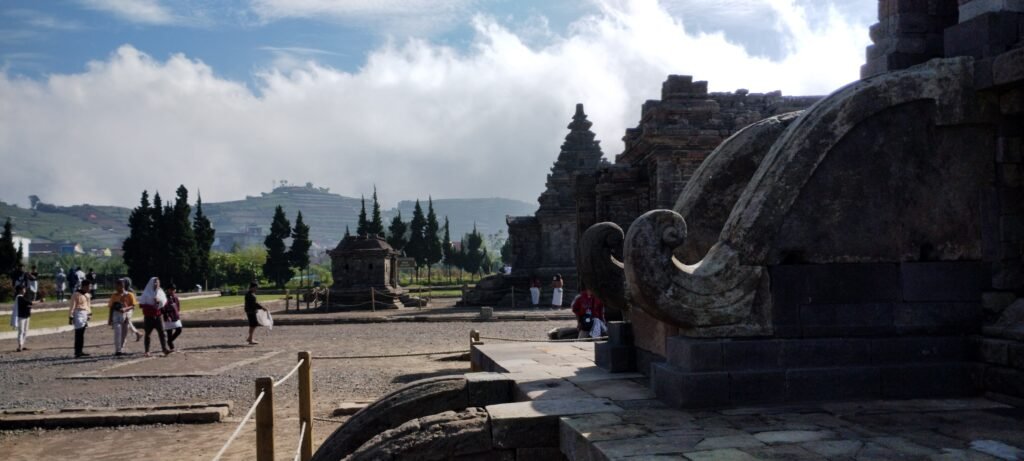
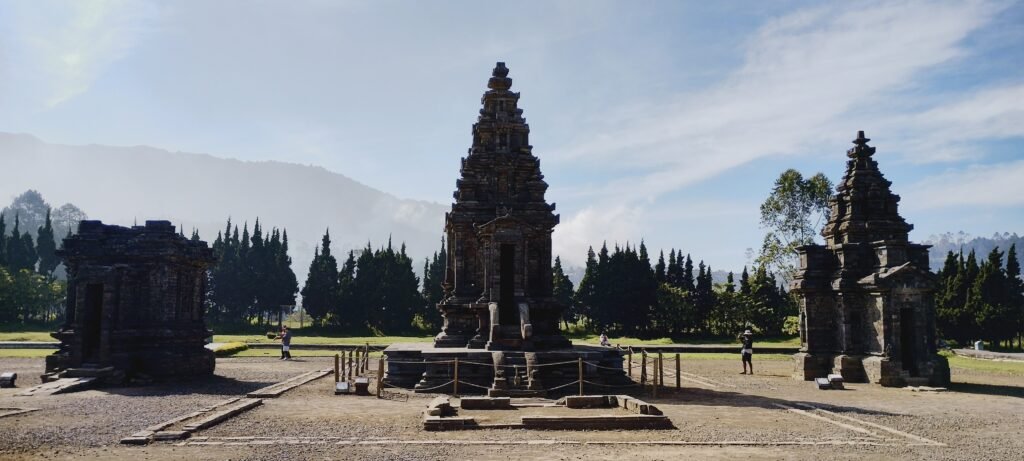
What would an observer see when they reach the Arjuna cluster at the plateau’s centre? Their gaze would first fall upon the complex’s layout. And there they would see the eastern row of four temples that face a fifth structure with a curved roof.
Holy direction
Following the rules of cardinal points, the eastern row lines up in a north-south direction. Its constituent temples all face west, and all take their name from the Mahabharata Hindu epic.
First, and most famed, is Arjuna, the row’s most northern temple. History records that in 1924, a Dutch archaeologist found that Arjuna’s design followed the rules of Vastu Shastra, wherein natural light, effective design and balance of the elements create a peaceful space.
Thus, Arjuna was once filled with cymbals, and decorative motifs to ward off evil marked its door and three of its niches. The door connects with the stairs, and in the middle of the temple sits the garbhagrha, the central sanctum of a Hindu temple. This middle room now sits mostly empty, save for the Yoni pedestal. But in days of yore, many splendid Shiva statues lined its walls.
Frames decorate Arjuna’s feet and lower body. Like the other Dieng temples, Arjuna has a flat frame. A trio of niches decorates three of the structure’s walls; a chinless head ornament adorns the top niche. Arjuna’s door faces west, and cheek stairs lead to two parrots, through whose gaping mouths holy water once flowed to those who worshipped outside the temple. This somasustra channel, a common sight in South Indian temples, is the only one of its kind in Indonesia.
Arjuna has three parts: Bhruloka (foot), Bhurwaloka (body) and Swarloka (roof). It also has five relug niches, two to the west, and one each for north, south and east, in which once sat statues. And atop the temple rests a roof of three layers in the South Indian Dravidian style. This roof covers the temple and emphasises its box-like shape, built from slabs of grey stone, which denotes the first waves of temple-building in Central Java.
Srikandi Temple
To Arjuna’s south waits Srikandi. This temple enjoys something else that no other temple in the complex can: a Hindu Trinity carved on the exterior walls. The temple has rectangular frames and several cube stones at its peak. Srikandi’s bas-reliefs are as distinct as any on the plateau and feature carvings of both Vishnu and Shiva.
Puntadewa temple
Puntadewa lies just south of Srikandi, and, as the tallest of the temples, looks down upon its fellows. It stands on a stacked batur and reaches a height of 2.5 metres. Little more is there to say about Puntadewa, which sits with dignified grace. Its relug juts from the wall and, unlike the other temples, its bar-shaped roof has survived the ravages of time and stayed intact.
Sembadra Temple
At this point, those heading south will have reached Sembadra, the southernmost temple in the eastern row. The observant will note a blooming lotus on its roof and a hole through which to display an arca and centre devotees’ worship of their chosen deity. Presumably, that would mean Shiva. The name Sembadra comes from Java’s wayang shadow puppet tradition, and she symbolises the notion of an ideal wife.
Semar Temple
The sole occupant of the western row is Semar. This temple faces east and sits across from Arjuna. Priests or the Brahman caste, who had sacred knowledge, performed religious rituals at Semar. Some have posited that people used this long and flat building as a place to store ceremonial equipment. Either way, a lotus frame adorns the body’s pedestal, and a kala-makara on the door wards off foul spirits.
A series of raised paths allows for easy access between the temples. But the most glorious thing about the Arjuna cluster, alongside their modest nature and unimposing size that draws attention rather than repels it, is their setting. The bowl that houses the cluster is long and flat, and most times, the sky above is cloudless and blue. This, coupled with the ring of peaks and mountains that shrouds Dieng, creates a refreshing, reflective scene and also a holy one, for it allows focus on the temples’ devout, divine essence. For the lucky observer, this devotion may yet seep into their body and soul, and shape how their spirit wanders the earth. And no more is there to say on the subject.
Things to know
Climate
The Dieng Plateau is cold, so wrap up accordingly
Getting there and away
EitM went straight to Dieng from Terminal Mendolo in Wonosobo. The journey took roughly a couple of hours and involved a bemo ride and then a bus to the plateau. The changeover took place on Jl. Dieng. Two people really helped: Ita, who runs a travel agency, Agen Tiket ITA (tel: +62 852 2624 1120), at the terminal, and a kindly lady who babysat us on the bemo leg of the journey and told us where to change. Ita knows her stuff and is reliable. She knows how best to reach Dieng. And like most places in Indonesia, a kindly passer-by will often be on hand to help where they can – a role filled in this case by kindly Ibu. Smoking was allowed on the bus, and it was a pure joy to spark up and savour the winding road and increasingly cold air on the climb to Dieng
Leaving Dieng for Wonsobo involved flagging down a bus on Jl. Dieng, opposite the Dieng Welcome Statue. The bus headed towards central Wonosobo and we got off at the alun-alun; it’d be a good idea to know where you’re going and have a vague idea of Wonosobo‘s geography just in case the bus isn’t going to your exact destination. Presumably a lot of buses end up at Terminal Mendolo
Accommodation
Flamboyan Homestay worked well as a budget option. But if it’s booked up or closed, there’s plenty of other places around
Tours + guides
A lot of accommodation will have contact numbers and adverts for tour guides, either for sightseeing, trekking or the temples. The Arjuna cluster is simple enough to see independently on foot (hours: 7am to 4pm; entrance: 30,000 IDR*), and Dieng is a nice place to mooch around. You’ll need a guide for the mountains
Respect
Dress conservatively for the temples – legs and shoulders covered, nothing revealing, and so on. Visitors receive a sarong to cover their legs and a sash to cover their shoulders. No footwear inside the complex
*might have gone up since the time of writing. That’s what it cost in 2023
Read More: Pohon Pengantin: The Bridal Tree of Salatiga, Java
Discover more from Eye in the Middle
Subscribe to get the latest posts sent to your email.