Hoàn Kiếm Lake: The Heart of Hanoi’s History
This page has affiliate links. If you click and buy something, EitM might earn a small commission, at no extra cost to you, the reader. As always, thanks for reading.
Hoàn Kiếm, at the heart of Hanoi, is a body of water that reflects a critical, turbulent time in Vietnam’s history. The lore that shrouds this lake is no less compelling, shaped by colonial conflict, an unbending rebellious fervour and the uncanny schemes of water-borne creatures.
Hoàn Kiếm Lake is a calming balm that sits next to Hanoi’s Old Quarter. The neighbourhood is a busy, hectic place. Blocks of tall, thin nhà ống tube houses sit above shops and cafes, and after dark, Tạ Hiện Beer Street, with its plastic stools and communal atmosphere, attracts many crowds, whistles whetted by the promise of freshly drafted bia hơi.
Around the Old Quarter coil mazes of tightly wound streets, which sell crafts and goods like paper, silver and silk, while St Joseph’s Cathedral, the oldest Catholic church in Hanoi, oversees the place from behind its dramatic neo-Gothic facade guarded by two giant belltowers.
Hanoi is soundtracked by the drone of motorbikes which sometimes quiets and recedes but never fully vanishes. The subliminal buzz can disorientate some newcomers. But it also tells of the sheer scale of life ensconced within Hanoi. Resting on the edge of this unending activity, Hoàn Kiếm injects a sense of calm and serenity into proceedings.
Read More: Lake Sarangan Lore: Dragons, Eggs and Enchantment in East Java
Lake forms
The oxbow lake formed after the Sông Hồng Red River changed its course. This gradual shift, which took place over centuries, left behind many swamps, ponds, and other water sites around modern-day Hanoi. The river moved east, leaving in its wake a giant body of water that would become Hoàn Kiếm and Hồ Tây West Lake to the north.
Hoàn Kiếm was once known as Lục Thủy, or Emerald Lake, on account of the water’s bright green sheen. The lake was also known as Thủy Quân, or Naval Lake, because during the Le dynasty (fifteenth–eighteenth centuries), the military employed it in training drills.
Hard life and disease
But for all of the emerald lake’s prettiness, it was still a muddy, harsh environment. The heat of the summer months made the water stagnant and choked it with algae. Disease-carrying creatures, in the form of mosquitoes, swarmed to this humid morass. The smell would have been overpowering, as was the unceasing attention of blood-sucking insects. And during the monsoon season, the lake often burst its banks, flooding the surrounding area and adding another level of chaos to the nascent city.
For a long time, the edges of Hoàn Kiếm played host to equally demanding living conditions. Villages sprang up around the lake, with many homes made of bamboo and thatch. But these fragile structures were subject to the elements, and easily flammable; more than once, fire tore through these homes, reducing them to ash and wiping out entire settlements.
The harsh realities of life were made even starker when, on occasion, criminals, pirates and political rebels were executed near the lake. Their severed heads were left in the open air as a warning to others. And as the flies and insects swarmed to devour this carrion, the inescapable ruthlessness of life around the lake would have become palpable.
Scholars and workers
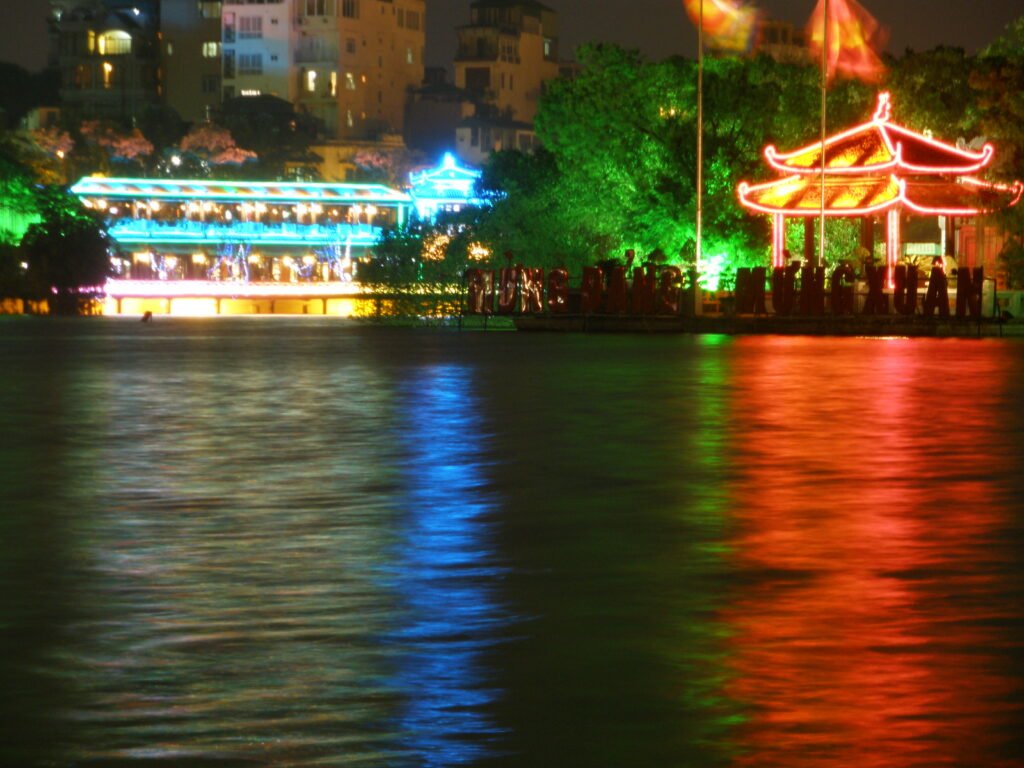
This friction revealed itself in a class divide. Around Ngoc Son Temple, or Đền Ngọc Sơn, to the north of the lake, the scholars, poets and mandarins of Hanoi gathered to drink tea and discuss philosophy, while close at hand, fisherfolk, water-carriers and tradespeople busied themselves with the day-to-day labour of life around the lake.
Hanoi was no different to any other city. Within its limits ebbed and flowed a complex social system, with conflicting ideals and priorities. These tensions heightened only further with the onset of an outside incursion.
The French conquest of Vietnam
By 1884, the French had finalised their conquest of northern Vietnam, which they called Tonkin. Previous attacks on Hanoi in 1873 and 1882 had seen the French claim the city, but guerrilla resistance and political uncertainty meant they did not hold the place for long. It was only the signing of the Treaty of Hué in 1884 that finally instituted Tonkin as a French protectorate, at the expense of the then-ruling Nguyen dynasty.
This new outside influence elicited many fundamental changes. Hanoi, the bustling ancient capital, with its villages and divine Buddhist and Taoist sites, became an administrative centre for the French colonialists.
The colonial gaze, scanning Hanoi, fell upon Hoàn Kiếm, which they decided to repurpose as the ‘Paris of the East’, and became a dividing line between France and Vietnam. A colonial quarter, comprising villas, wide, open boulevards and grid-style streets, sprung up to the lake’s south east, while the northern Old Quarter stayed as it was.
Times of change
Parts of the lake were also filled in, to create space for these changes. Formerly, the body of water, known as known as Tả Vọng Lake ,comprised two halves: Hoàn Kiếm and Huu Vong. French engineers filled in the latter and many of the surrounding marshes, forever altering the landscape in the name of colonial expansion and clout.
Equally as destructive, the French tore down many-a spiritual edifice, such as the pagoda of Bao An, the largest such structure in northern Vietnam, torn down to make way for a post office. Today, only Tháp Hòa Phong tower remains standing, the sole remnant of this Buddhist centre and a gaping reminder of what Hanoi lost during the colonial period.
Overhaul in Hanoi
The French were keen to establish dominance over the populace, which they did by overhauling established and deeply integrated socio-cultural patterns. Some changes, such as the geometric European road system that replaced the city’s sweeping, winding pathways, diluted much of Hanoi’s former character.
But in draining the wetlands and installing a central sewage and sanitation system, the colonialists substantially lessened the threat of diseases like malaria and cholera. Dirt roads were paved, and by 1900, electricity freely flowed around the French Quarter, powering a working tram system as it did so.
Vietnam’s culture and language also came under threat. The colonial powers made French the compulsory language of bureaucracy, education and law, while the civil service exams, an ingrained part of Vietnamese administration and scholastic life, were phased out.
Financially, the yoke of colonialism weighed heavily upon the colonised Vietnamese. The French took control of resources and introduced severe levies on alcohol, opium and salt, alongside imposing heavy taxation across the city. A quiet resentment fermented within the population, making itself known in the form of subversive behaviour.
Read More: Lake Toba: How Did Sumatra’s Most Famous Danau Get Its Name?
Vietnamese resentment
The physical changes introduced by the French did not go down well. The boulevards and wide-open spaces, so evocative of France, were often shunned by the Vietnamese in favour of the Old Quarter’s maze-like streets and cramped, intimate social venues.
And despite the French push to remove Chinese characters from written script, the city folk pushed back. By 1907, they had launched Đông Kinh Nghĩa Thục, or the Tonkin Free School, close to Hoàn Kiếm. There, they published anti-colonial screeds and poetry using Quốc Ngữ, the very same Latinised Vietnamese mode of writing promoted by the French.
But it was the café society around the lake that bred the most subtle dissidence. The French brought with them a specific lifestyle, most visible through the baking of baguettes, the drinking of coffee and the leisurely stroll. Each was a way for the French to institute their culture and mimic their lives in Europe.
Bread etiquette
Baguettes, for instance, were only to be eaten indoors, with the only acceptable ingredients being butter or liver pâté, spread evenly and demurely with a knife. The French insisted that this strict protocol symbolised European refinement, and that the Vietnamese could never change it in any way.
The Vietnamese, though, did change the etiquette and the protocol, and they did so wholesale. By the mid-twentieth century, they were slicing the bread down the side, and stuffing it full of crisp vegetables, fresh coriander, pickled daikon, soy sauce, and meats. The baguette became the everyday street food of the working-class layperson, and an accessible, democratic refusal of European luxury.
Coffee culture
Coffee, too, was an abstract staging ground for a cultural conflict. The French had a specific way to drink coffee: hot and black, garnished with expensive condensed milk imported from France. The coffee was planted for export and harvested on plantations using forced labour. Coffee was not a consumable for the Vietnamese to enjoy.
But again, the Vietnamese took something intended to demarcate the coloniser and the colonised and claimed it for themselves. First, they used cheaper robusta beans rather than the more expensive arabica beans favoured by the French. And then, they brewed the beans slowly in a phin filter, mixing it with the same condensed milk used by the colonists. The Vietnamese hijacked French coffee culture, and made it affordable for everyone.
Chinese occupation in 1407
But this civic pride and resistant spirit in Hanoi was not a new phenomenon. Looking back to the fifteenth century, for instance, reveals a similar story. This was the time of the rebel leader Lê Lợi (1385–1433), from Lam Sơn in Thanh Hóa province. The Chinese Ming dynasty had occupied Vietnam, renaming the region Jiaozhi, and their actions elicited eventual rebellion.
The 1407 invasion, led by the Yongle Emperor, heralded a 20-year occupation by the Chinese, characterised by cultural erasure and human rights violations. To this end, the occupiers purged Vietnamese culture, either burning books, poems, scrolls and historical records, or confiscating them.
History erasure
Whole swathes of Vietnam’s history and written word went up in flames by imperial orders. The country’s leading minds, such as mathematicians, historians, doctors and scholars, fared no better, being swept up and deported to China against their will. Those who stayed were forced to wear Chinese-style clothing and subjected to severe punishments for practicing Vietnamese traditions like chewing betel nuts.
This tyranny did not extend solely to Vietnam’s culture and heritage. By their actions, the Ming sought to break the Vietnamese resilience. The occupiers co-opted the country’s mines and resources, forcing labourers to undertake dangerous pursuits like deep-sea pearl diving and scouring the dense jungles for gold, elephant tusks and wood.
Thousands died as a result, lost to animal attacks, drowning, illness and exhaustion. Terror tactics employed by the Ming, such as dawn village raids, sexual violence and the summary slaughter of the elderly or military-age men, struck further crushing blows across the country.
Punishment and violence
Lê Lợi watched on as his country’s villages burned, its people worked to death or slaughtered, its culture systematically wiped out. The Ming instituted a cruel system of collective punishment and heavy taxation, employing severe violence to pacify ordinary people. But rather than subjugate Vietnam, they turned these same folk into rebels. Lê Lợi himself suffered under the Ming: his young daughter was forcefully abducted and sent to a harem in Beijing, and he was denounced and hunted as a security threat. This deep-rooted trauma fuelled a ten-year guerilla war.
Guerrilla low point
In 1418, Lê Lợi launched the Lam Sơn Uprising with a vastly outnumbered force that lacked weapons, equipment and formal training.
Ming forces dominated the rebels, forcing Lê Lợi to lead his forces back into the mountains and forests of Thanh Hóa to regroup. There, starvation, illness, and a loss of hope took their toll on the struggling resistance, intensified by yet another crushing defeat to the Ming that forced the rebels to eat their horses to survive. By 1420, the fight against the occupiers had become desperate.
There was also, however, a sliver of hope. Lore tells that Lê Lợi’s resolve came, in part, from a mystical sword. Vietnamese across all strata of society took up arms against the Ming and joined Lê Lợi’s rebels. These included a fisherman named Lê Thận who, one day, was fishing in Lục Thủy when, of a sudden, his net fell victim to a curious and powerful weight.
The bulky weight initially proved too difficult to land. Three times he tried, and twice he got no purchase on the heavy load. But on the third time, he succeeded, and the source of this dramatic load became clear. Nestling amongst the fish was a magnificent blade that Lê Thận instinctively knew could only belong to the Dragon King, Long Vương, who lived beneath the surface. The underwater monarch had bestowed a gift for the resistance, at a time when Vietnam was under duress.
Read More: Boeung Kak: The Sad Loss of Phnom Penh’s Lakeside
Pressure and release
Lê Lợi bore the weight of this pressure. For all their attempts to meet the Ming on an equal footing, the rebels fell to defeat after defeat, one of which saw the rebel leader fleeing Ming forces. He ran into a forest and climbed a banyan tree to evade his pursuers. On his way up, something caught his eye: a glint of something precious high in the branches above him. He continued to ascend and found a beautiful, jade-covered sword hilt in the tree.
The warm glow filled Lê Lợi with a nameless, sourceless sensation, similar to the feeling of observation by a well-meaning, infinitely kind benefactor. He took it as a sign that Heaven had not abandoned him and yanked the hilt from the tree. Soon enough, he visited Lê Thận’s house, where the fisherman’s own mysterious blade began to glow with the same light as the hilt.
Something was happening. The pair brought the blade and hilt together, watching as they merged into a single weapon. Upon this sword glowed an inscription: “Thuận Thiên”, or “the Will of Heaven”. A greater power had something in mind for Vietnam: total unification of the Vietnamese people, displayed through the bond between the leader Lê Lợi and the common citizen Lê Thận.
Fighting the Ming
The power of the magical sword Thuận Thiên symbolised a turning point in the conflict, as though it had charged the struggling rebels with the divine power to reclaim Vietnam. Thus emboldened, Lê Lợi rallied his troops to remove the occupiers. Thousands of ordinary folk joined the fight, inspired by his connection with Lê Thận. The resistance swelled into a unified army.
From their mountain bases, the Vietnamese marched south, where they took control of Nghệ An and Thuận Hóa. This was a shrewd move. It gave the rebels a territorial advantage and trapped the Ming in the north. Despite their superior numbers, the Chinese could not match the rebels’ knowledge of Vietnam’s terrain and suffered ambush after ambush, rout after rout.
Soon enough, the occupiers, cut off from Beijing, their numbers decimated and their will broken, formally surrendered. The Ming forces withdrew from northern Vietnam in 1427, ending two decades of violent rule.
Lê Lợi meets the turtle god
The next year, Lê Lợi, having returned to Hanoi, was crowned emperor. The Ming were gone, the war finished, the country at peace. But the emperor still had some tasks to attend to, and made his way to the emerald waters of Lục Thủy. There, he took a dragon-boat ride, carryingThuận Thiên with him.
Of a sudden, a ripple played upon the water’s surface, that heralded the arrival of a shimmering, gilded shell. The shell enclosed a turtle, which swam next to the victorious emperor. Creature and boat glided side by side across the lake. And then, the creature announced itself as Kim Quy, turtle god and envoy of the Dragon King Long Vương.
Kim Quy declared that in routing the Chinese, Lê Lợi had exercised the Will of Heaven. And now it was time for the humans to relinquish the sacred blade. Lê Lợi gladly did so. The blade had served him, and Vietnam, above and beyond the call of duty.
Kim Quy
The emperor unsheathed the blade and handed it to the turtle God. Kim Quy, blade in beak, submerged into the depths, where it restored the sword to its rightful master.
In honour of this event and the divine aid in freeing Vietnam from its invaders, Lê Lợi renamed the lake Hoàn Kiếm, or the lake of the Returned Sword. The water bestows a pocket of calm in the midst of frenetic Hanoi, where it symbolises Vietnamese strength and will, and changes colour in reflection of the sky overhead.
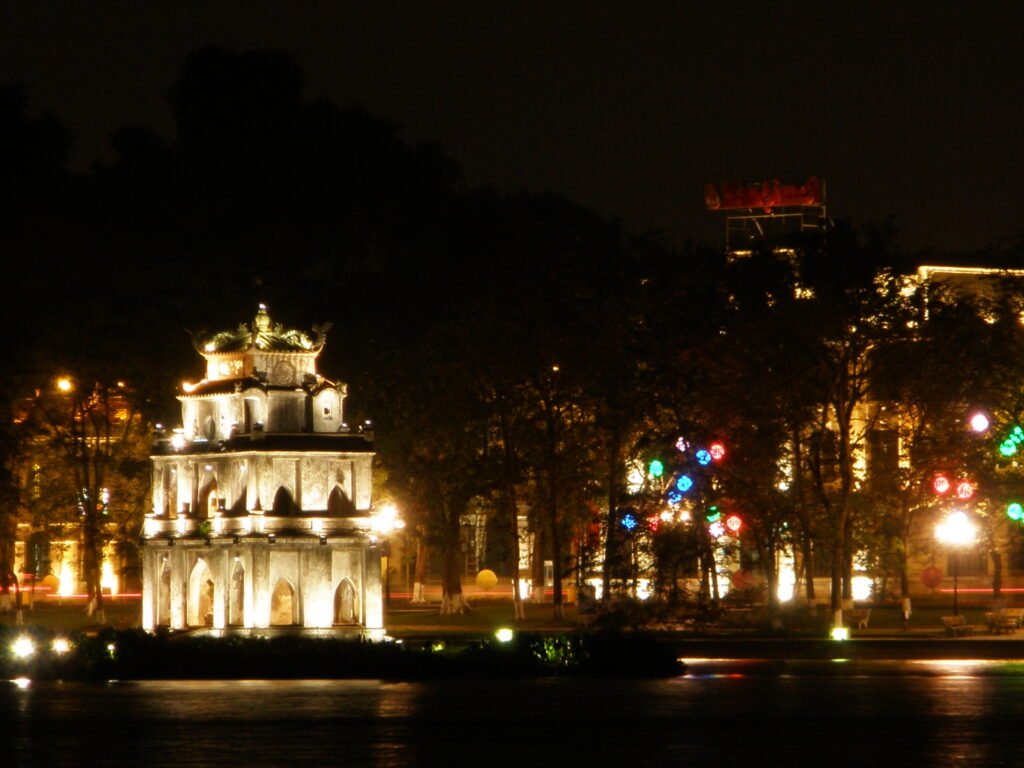
But the link between Hoàn Kiếm and turtles does not end there. Towards the centre of the lake is a small island, inaccessible by bridges and devoid of boats, upon which rests an isolated stone pagoda. This is the Turtle Tower, or Tháp Rùa.
Tháp Rùa
Tháp Rùa has stood in place for hundreds of years. In the fifteenth century, the first iteration of this edifice appeared in the form of a resting place for Emperor Lê Thánh Tông as he fished on the lake. A few centuries later, the building took its next form, this time in the shape of Tả Vọng Temple, built by the noble Trinh clan under the Revival Lê dynasty. But by the eighteenth century, this temple had also vanished.
Turtle tower symbolism
By 1886, the French had occupied Vietnam. And in Hanoi, Tháp Rùa prepared to take its next form, which would cause public outrage. Nguyen Ngoc Kim, an intermediary between the Vietnamese and French authorities, and despised by the Vietnamese as French collaborator, received permission to build a tower on Hoàn Kiếm.
Ostensibly, he sought to honour the efforts of Lê Lợi in freeing Vietnam from the Chinese. But Kim had an ulterior motive. He also planned to inter, in secret, his father’s remains within the tower, which he dubbed Tháp Bá Hộ Kim, or Bá Hộ Kim Tower, in honour of himself.
This plan came to naught. Citizens of Hanoi rumbled his scheme and, angered by the disrespect of disturbing the lake’s sacred dragon’s vein, dug up Kim’s father’s bones, which they threw into the lake. They christened the building Tháp Rùa, or Turtle Tower, in tribute to the spot Lê Lợi returned the magical sword Thuận Thiên to the turtle god Kim Quy.
Mini statue
In 1890, the French colonists decided they would add their own touch to the site. Thus, the colonial powers put a miniature Statue of Liberty on top of the tower. The French considered Hoàn Kiếm the heart of Hanoi and thought the addition would visibly rubber-stamp their authority.
The Vietnamese, though, did not feel the same way. Patriots responded each night by swimming out to the island and raising the revolutionary flag of resistance atop the tower, from which it fluttered, even obscuring the mini statue. From one century to the next, from the time of Lê Lợi, the tower embodied opposition to outside rule.
French rule lasted until 1945, when they were ousted in the August Revolution. The public, free of the colonists, tore down the statue. Some even wanted to demolish the tower itself and remove the symbolism of its origins. But the revolutionary government had other plans. They kept the tower in place and proudly flew the Vietnamese flag upon it.
Tháp Rùa’s design
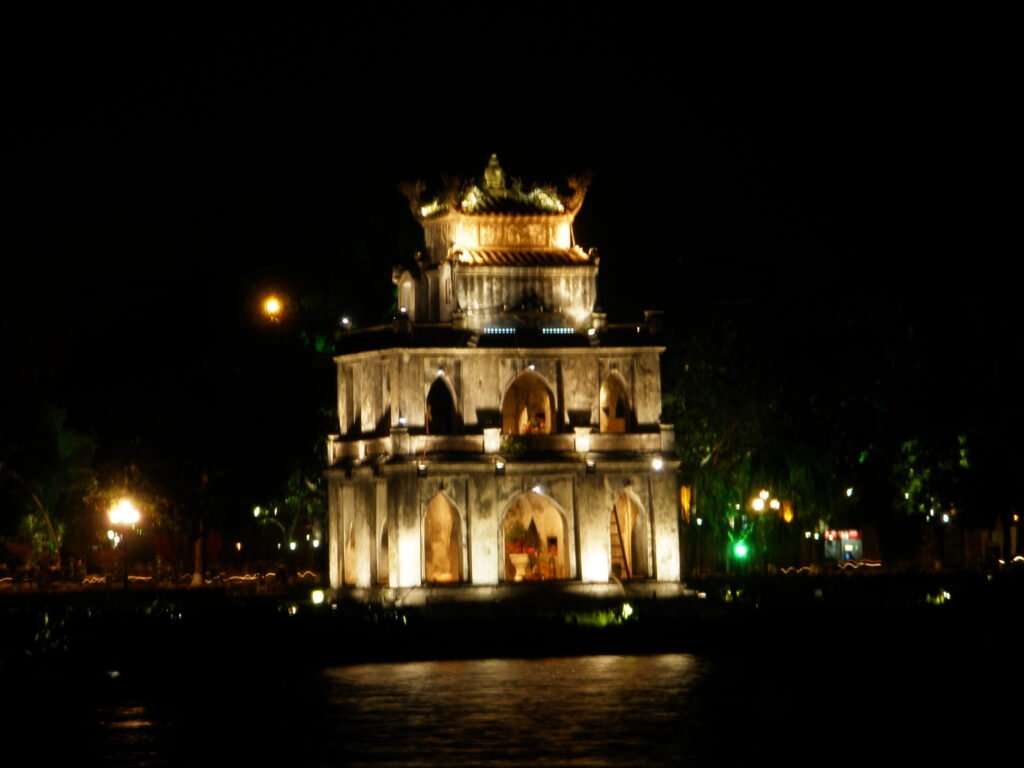
While Tháp Rùa may have conveyed an air of dissent, its design blended Western and Asian styles. The three-tiered structure becomes thinner with each rising level, culminating in a curved roof with the distinct mottled tiles, writhing dragons and shrine so common in Vietnam’s spiritual sites.
The outline is that of a pagoda-style structure, that many visitors to this region will know and recognise. Arched doorways, that mimic Gothic traditions, allow entry into the tower and imbue it with an open, welcoming air, as if to say there is nothing to hide or fool the observer. Once inside, a visitor that reaches the third storey will find the engraving “Quy Son Thap”, or “Tower of the Turtle Mountain”.
Strong base
Tháp Rùa’s strength lies in its stockiness. A hurricane would struggle to knock this tower from its bearings, as would a typhoon, tornado, derecho or cyclone. The thick bottom denotes elemental might, as though syphoning power from the earth itself. And this reflects the toughness of the Vietnamese and their efforts to stave off the encroaching reach of colonial power, and that tenacity has taken root and passed down through the ages. Hanoi is a place of tradition and history, and Tháp Rùa emanates such grace from base to tip.
This oneness extends to the tower’s brickwork, rendered aged and moss-covered by many years’ exposure to the elements. So weathered, Tháp Rùa blends in with its surroundings and has become as much a part of the landscape as Hoàn Kiếm itself.
And the tower’s namesake creatures still make their presence known. Reports over the years have abounded of giant softshell turtles, or those of the species Rafetus leloii, named after the rebel leader, in the lake. But more recent sightings featured only a single turtle, by all accounts very old; some measured its age as more than a century.
Cụ Rùa
The creature evoked some interesting notions. Was this the same beast that reclaimed Thuận Thiên from Lê Lợi all that time ago? Ever-protective, did the turtle patrol the lake? Was this the protector of the magical sword? The answer would remain an enigma. In 2016, the turtle, known as Cụ Rùa, or Great-Grandfather, was found floating dead in the water.
Cụ Rùa’s death prompted intense mourning in Vietnam. In honour of its status, the turtle was preserved and embalmed, and placed on display close to Đền Ngọc Sơn. Its place as a guardian of the lake is assured and offers the tantalising prospect of mythology being made flesh, especially when this myth charged the lifeblood of Hanoi, the city that surrounds it.
Hanoi: accommodation, flights, activities
Discover more from Eye in the Middle
Subscribe to get the latest posts sent to your email.