Gili Iyang: (Very) Vague Guide to Pulau Oksigen
This page has affiliate links. If you click and buy something, EitM might earn a small commission, at no extra cost to you, the reader. As always, thanks for reading.
Gili Iyang is a pretty, unassuming island on the east coast of Madura that goes by more than one name. Why do some sources call this place Pulau Oksigen?
At Dungkek port, near the easternmost tip of Madura, Indonesia, sits a long, thin jetty that juts out into the Bancamara Strait and casts a deceptive spell on some visitors. The jetty offers very little shade, and when the sun glares down on Dungkek, whoever stands there has to take care not to let the piercing gaze from above disorientate them.
The heat can confound the senses. An entirely plausible scene, like the loading of bricks from truck to hand to vessel, as so often happens at Dungkek, suddenly becomes too strange to understand, and drives those unused to the glare to seek the relief of shelter. From their shaded position, the visitor can prepare themselves for the trip to Gili Iyang. They take their rest as the industrious clanks and scrapes of the brick-loading quickly fade out and float across the bay.

Reaching Gili Iyang from Dungkek Port
Reaching Gili Iyang from Dungkek requires passage on a motorised wooden boat that ferries to and from the island like a sea taxi. These boats come in different shapes and sizes. The most common measures roughly the same size as a Madurese fishing boat and comprises two halves. Passengers tend to congregate at the back, where they cram together on a flat space with enough room for about ten people. A tarpaulin offers solace from the sun, and the more passengers there are, the more jostling there is to escape its dazzle.
The other half is reserved for luggage, bags and parcels. Many of these packages, wrapped in hessian or tied into bulky bundles, give no clue as to their contents.
The motorbikes placed to the sides of the boat are more obvious beasts. They balance perfectly, avoiding the whims of the tides and the deities that control them, and never topple into the sea. Their shining chrome bodies contrast with the weathered, mottled wood of the boat. All the same, the bikes’ bulk seems to shrink when the crossing begins, as though the craft has sailed into a temporary parallel dimension where size changes at will.
Read More: Pamekasan [Very] Vague Guide: Enjoy Madura’s Rich History and Culture
Calm crossings
The departing vessel often passes lis-alis boats, their crews busying themselves with fishing or moving goods. The lis-alis is native to East Java and common in southern Madura. They have triangular lete sails and high curved bows, and bright colours and intricate carvings adorn their bodies. Yet the most striking part of the lis-alis is its curved hull, which gives the boat the look of an inverted eyebrow scything through the water.
Most crossings pass calmly and slowly. The stuttering clank of the boat’s engine tends to lull the passengers into quietness. And as the craft heads towards the rocky coast of Iyang, this same hypnotic pulse seeps into all parts of the vessel, so that even the bikes mind their manners. Like the other passengers, the machines make the most of their allotted space, sitting with the same quiet deference that younger generations in Indonesia typically reserve for their elders.
After around 45 minutes, the boat docks at a stone jetty on the western side of Iyang, near Banraas. The engine stops, the pulse recedes, and the daze that reigned over the boat comes to an end. The passengers have reached Gili Iyang, an island that, for most newcomers, is coloured by a vague sense of mystery.
Gili Iyang or Pulau Oksigen?
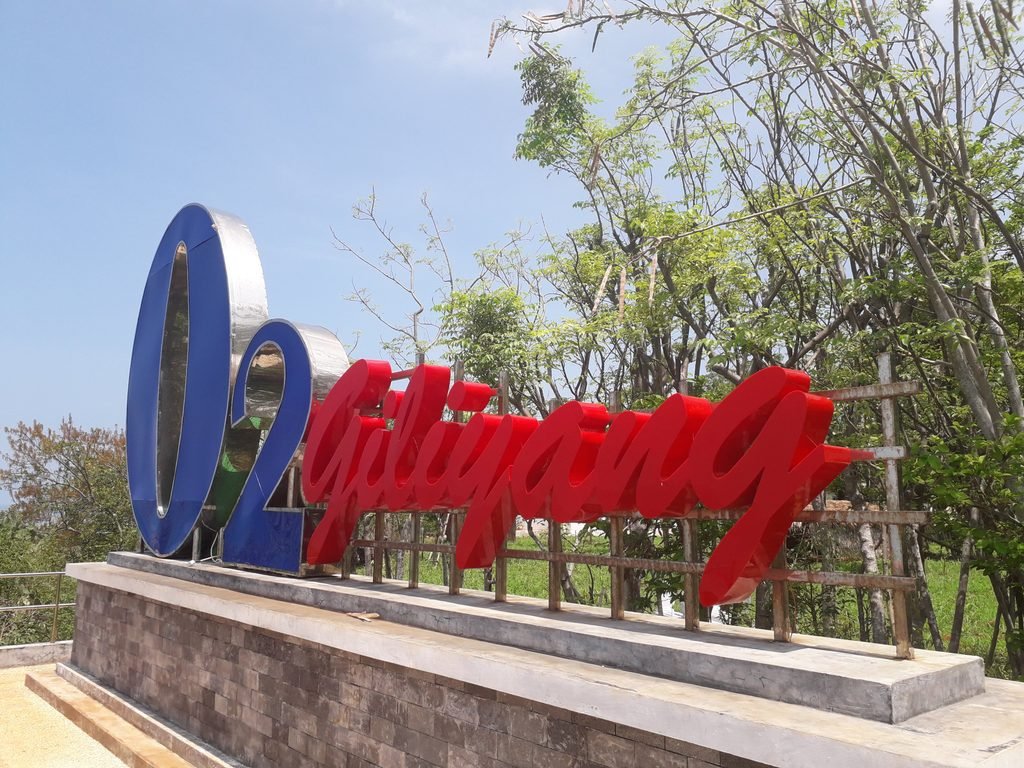
Gili Iyang is also known as Pulau Okisgen, or Oxygen Island. The alternate name stems from the fact that the island has the second-highest level of oxygen on the planet, behind only the Dead Sea in Jordan.
Studies by institutions like LAPAN (National Institute of Aeronautics and Space) have found that on Gili Iyang, oxygen levels range from 20.9 per cent during the day to 21 per cent at night. The figures peak at 21.5 per cent. Similar levels appear in forest, ocean and polar biomes across the globe. These other places, though, are remote, and most likely little more than coordinates on a map. Pulau Oksigen can at least claim to be the world’s most accessible site for such high oxygen levels.
Not that bells and whistles and grand assertions accompany such a title. At its core, Gili Iyang remains a humble, down-to-earth island. Its uniqueness lies in how it maintains the purity of its air. While many places suffer from excess pollution and emissions, which drag oxygen levels down to 18 per cent or even lower, Pulau Oksigen bucks the trend. It is not an industrial, urban place, nor is it powered by arcane spells or rituals.
Instead, the island has an environment conducive to living well. It has no factories that belch plumes of foul smoke from distended chimneys. The island’s thin, uneven roads, meanwhile, mean cars cannot drive along them, and so stay away.
An occasional motorbike takes their place. But even then, these vehicles do not appear in anywhere near the same numbers as on the mainland. Instead, acres of trees and plants claim the most space. They breathe out a constant supply of oxygen, blown around by the sea breeze. It is a natural, democratic process that grants everything the same access to pure, clean air.

The feel of Gili Iyang
Visitors to Gili Iyang often find that the oxygen-rich air is slightly thicker than they might expect. This weight reaches its peak at Oxygen Point, in Bancamara village. Here, on the south of the island, red earth covers the site and swallows the gazebos dotted around the place. The ground’s earthen colour evokes the sense of looking at an old image, slightly worn and tinged in sepia. It is a sleepy, dreamy scene that leaves the beholder at once present and removed, as though the heavy air, unable to move their bodies, has drifted off with their minds instead.
There is little motorised noise on Gili Iyang, save perhaps for the passing rumble of a motorbike or a fishing vessel phut-phutting by on the ocean. This lack of drama conjures the idea of things minding their own business, away from the outside world. And as the notion settles, it soaks into the calm aura that rings the island.
Read More: Sumenep: (Very) Vague Guide to the Soul of Madura
The lore of Pulau Oksigen
But while research and reason position Iyang’s oxygen levels at the door of its verdancy, folklore offers another view. From this standpoint, the oxygen carries the weight of ancestral blessings. These blessings circulate through Iyang into its every corner. Island lore tells that, like many areas in Java, the spirits hold much sway over how the place flows.
On Iyang, the breeze hangs with a subtle weight. When it settles, it does so with a gossamer-like softness that ripples along the lines of ancestral lineage.
Before long, the breeze increases in heft and significance, as though the air is the breath of ancient ancestors guarding the island and its inhabitants. The resulting sensation bears all the hallmarks of calm agelessness that shields its recipients from illness and the ravages of time.
All of this grace exists against a backdrop of barakah spiritual energy. Iyang is an Islamic island. Divine harmony strengthens the pillars of belief and legend, and does so with a power that throbs and vibrates without a sound.

The Legend of Ju’ Senggora
Science and research help explain how sea breeze patterns and a lack of pollution contribute to Iyang’s high oxygen levels. But a more fanciful telling awaits in the annals of island tales that celebrate the life of Ju’ Senggora, one of the island’s spiritual guardians.
Ju’ Senggora is one of the pillars of Gili Iyang’s unique essence. Lore places him as the first person to clear the island’s dense undergrowth. He then established a settlement at what is now Banraas village, on the eastern side of Iyang. The villagers came to revere him as a venerable mystic who wielded the power to shield islanders from disaster.
Ju’ Senggora was a vessel of karamah, a divine gift bestowed upon non-prophets that, amongst its many strands, bonded the recipient with the elements. Storytellers shared how he used his spiritual gift to protect the island community. Once, when extreme drought blighted Iyang, making crops and water scarce, hope dwindled. But legend has it that Ju’ Senggora prayed and struck the ground, from which burst a wellspring of fresh water.
This unexpected boon was revered as a sacred blessing. Ju Senggora had averted a crisis. Even now, visitors to Gili Iyang drink its hallowed water to absorb the same cleansing gifts as those carried in the air.
By his actions and prayers, Ju Senggora cemented his legacy as a guardian of the island. His deeds soaked into Pulau Oksigen and pulsed around the place, merging, like the strands of a DNA helix, with the water and the air to help free the island of disease and negativity.
Breath of fresh air
Today, it is commonly held that the island enjoys the benefits of fresh, high-oxygen air. The seeds of this purity have sprouted in different directions. Numerous independent sources, for instance, have alleged that individuals on Gili Iyang, ranging from Ju’ Senggora to the present day, have lived long lives, well into their hundreds. So doing, they lend credence to the idea of the island’s wondrous nature.
Such stories, of course, breed speculation. But they might, just might, also hold some real depth. Perhaps the answer lies halfway between beautiful lore and mundane reality. Regardless, it does raise the question as to why some quarters describe Gili Iyang as a ‘fountain of youth’, and why, ultimately, no one has discarded the label out of hand.
Jalan jalan Gili Iyang
From a distance, and depending on the season and the sun’s intensity, much of the ground on Gili Iyang looks red and brick-like. The earthen colour suggests that buildings cover the entire island, or that the ground itself is rusting. But it soon becomes clear that the earth, with its rich smell and spongy feel, is vibrant and firm, and that settlements are, in fact, spread out. Instead, much of Iyang’s land is given over to agriculture, trees and open fields.
Crisscrossing the island on foot reveals many paths that bisect Iyang and connect its villages. These interior routes cut through forests, canopied like archways, and offer glimpses of rural homes and healthy-looking fields. There is very little noise, save for the occasional bird call. Commotion only seems to arise when commuters have to make way for riders trying wanly to balance giant logs on the backs of their motorbikes.
The pace on Gili Iyang is much like many rural islands in Indonesia. Folks go about their lives, the call to prayer sounds from minaret towers at regular intervals, and a large selection of islanders look to be employed in moving lumpen pieces of wood and sacks of produce from one place to the next.
The welcome to outsiders is often polite and cordial. Initially, it is tinged with friendly incredulity, as though to say, ‘You’ve come here?’ But the shock quickly passes. In its place appears an invitation to join a gathering in a roadside gazebo, indulge in a coffee and cigarette, and otherwise bask in the warmth of a passing friendship.
Read More: Madura Island: (Very) Vague Guide to Pulau Garam in East Java
Friendly encounter
One day, EitM, walking along a stretch of road we failed to catch the name of, met a friendly pair of villagers. One was on foot, and the other idled on a Harley-Davidson motorbike. It was, at first, a slightly jarring image. The size and heft of the machine, far bigger than the automatic scooters used by most folk on the island, made it look, in such a benign, quiet place, as anomalous as building a sandcastle with a dump truck.
Once again, though, the calming nature of Gili Iyang took hold. Perhaps it was the notion of being on an outlier island, or the openness of the space in which it sat, but the bike seemed far quieter than its mainland counterparts. It purred contentedly as its rider proudly recalled a road trip he had taken across Bali on that very same machine.
The chat followed its course and soon came to a natural end. And when it did, the pair, before they went on their way, once more bade us welcome, followed by an entreaty to enjoy our time on Pulau Oksigen.
Community vigilance
EitM spent a very happy couple of days on Gili Iyang. We met a lot of residents, and through each of these meetings, we learned a bit more about the underground information network that permeates Madura.
We had come to Iyang as the guests of a friend from Sumenep, who had offered to show us around his home island. EitM didn’t want our hands constantly held, nor did we want our friend to miss out on valuable family time, so we agreed upon a loose schedule that freed up space for personal commitments on the one side, and unaccompanied roaming on the other. It was an ad hoc, easy-going arrangement.
But whenever we met up with our friend, he’d tell us, with a chortle, about blunt texts and WhatsApp messages he had received about not looking after us, and that he had somehow let himself down in the process. Not only that, the messages implied, but he had also made the people of Gili Iyang as a whole look like they too had failed in their efforts as communal hosts.
We, of course, had no clue that an innocent wish to see some of the island on our own had caused an undercurrent of tension. The whole thing left EitM feeling sheepish, as though we’d unwittingly got someone into trouble. It also spotlighted a subtle philosophical clash between islander and outsider.

Both sides of the coin
A visitor to a place like Gili Iyang often has the natural instinct to wander off, very happily, on their own and get to know an unfamiliar place. However, on Oxygen Island, this desire appeared to trigger the equally instinctive Madurese impulse to learn who this newcomer was, their general bearing and why they were left without company.
Each side, the situation indicated, had placed an unexpected burden of social pressure on the other, recorded in real time via WhatsApp, text message and verbal update. It felt, we thought, a bit much: us, struck by a pang of guilt simply for doing our own thing, and the community, dutybound to divert time and resources to establishing a stranger’s bona-fides. But then again, it wasn’t our home at the mercy of a potential troublemaker, and the vigilance made sense.
The situation also showed that a visitor to Madura can never truly blend in. The Madurese abide by the notion of collective care. This means that communal guardians chart, without malice, the movements of a new face. They do so as a duty to safeguard the visitor and ensure that they don’t breach any religious or cultural mores.
Any trouble tends to result in the sudden materialisation of someone to help sort that issue before, usually, vanishing again. The Western notion of minding one’s own business takes a back seat, in favour of the powerful sense of hospitality that abides on Gili Iyang and across Madura.
Pantai Ropet
Pantai Ropet, on the north-eastern quadrant of the island, lies near Banraas village. This viewpoint drops into the ocean rather than leading into it, giving the impression that the island has suddenly stopped. The lack of a long stretch of beach hints at chaos and danger, a stark reminder that for all Gili Iyang’s prettiness, nature controls the place with unfeeling force.
Standing on Ropet’s sharp edges evokes images of churning waters and crashing waves, fed by fiendishly strong currents. It’s not hard to picture shipwrecked fisherfolk washing up to dry land, having only just escaped their craft as the violent sea tore it to pieces.
But for all this supposed violence, Ropet is, at its heart, a splendid place to relax. There are spots to sit and take shade, from which some visitors can try to make out the islands of Sapudi, Pajangan and Bulumanuk further east. And the signposts at the core of the peninsula give the feeling of a crossroads, as though everything centres upon Pantai Ropet, which accepts its position with understated grace.
In October 2004, the remains of a colossal whale washed up at Ropet. The skeleton measured 20 metres long by 4 metres wide, and it caused alarm amongst the villagers, who viewed the bones as a bad omen. Peril never came to Gili Iyang, however, and the island community soon came to accept their deceased visitor, housing it in a wooden shelter overlooking the ocean from which it came.

Batu Cangga
To the southwest of Gili Iyang, on the edge of Desa Bancamara, there once stood an awkward staircase. The stairs were held together by rope and ricketed ominously. They gave the impression that they could, at any point, collapse into the ocean below. Since then, a far sturdier stairway has taken its place, marked in the subliminal Madurese motif of green and yellow, which signifies the importance of care, community and faith.
The stairs grant access to Batu Cangga, a unique rock formation on a karst hill. It is a dramatic, precarious spot with no natural footholds, set along a curving path that teeters on the edge of a sheer drop into the sea. Jagged limestone outcrops, shaped by the elements into pillars and archways, line the way.
The path culminates in a lookout spot overlooking the open ocean. Batu Cangga itself, five metres high and two metres wide, seems to prop up the entire cliff, bringing to mind the girth and clobbering power of a weathered prehistoric club.
A keen sense of isolation colours this part of Gili Iyang. The rock absorbs much of the island’s ambient noise, and there’s nowhere to turn or look except out to sea. And the solitude grows only stronger when an occasional lone fishing boat phuts past, its engine noise diluted to a distant drone.

Age and vitality on Gili Iyang
The lack of heavy industry and motor vehicles keeps air pollution low on Gili Iyang. Those who live there avoid the noise of urban life. The island doesn’t fully escape the pressures of day-to-day anxiety, because nowhere can, but it does offer some respite from the stress of towns and cities.
Clean living, in the form of farming, fishing and exercise, keeps people active and gives them a strong basis from which to reach old age. Claims abound that lifespans on Iyang reach well above the Indonesian average of 69 for men and 73 for women. Nearly a quarter of the island’s residents reach 80 years of age.
Clean living
Some tales go even further, telling of residents who reach 150. Bear in mind, though, that the world’s oldest recorded person was 122, and Iyang is not so far away from everything that life continues there unchecked. Such a claim, perhaps true, perhaps not, calls for a bit of scepticism.
Few can deny, however, that on the island, thanks to its clean air and its verdant, arable lifestyle, many inhabitants retain their faculties. Moreover, they do so even as time catches up with them. Their continued vitality shows the subtle miracle of a prolonged existence.
EitM once saw a Gili Iyang old-timer shimmy, unaided, up a palm tree. This is an impressive skill at the best of times, and in this case, that feeling grew when we learned the man was well into his eighth decade. Regardless of age, though, he completed his ascent in mere seconds. The natural, smooth movements told of a person with a lifetime of such practices behind him.
He quickly reached the top, and we could hear him hacking away at the foliage. Before long, he began his descent, having harvested a sizable crop of lontar palm juice. His movements, at least to the uninitiated, were exhausting to watch, and we felt a pointless, irrational fear for the safety of someone who was clearly an expert in his field.
Mostly, however, the scene felt entirely natural and indicative of an active life. Action complete, the gentleman went about his business. His manner was calm, and his attitude content, and we were left slightly confounded, once more, by how things really worked on Gili Iyang.

Things to know
Accommodation on Gili Iyang
- EitM organised a homestay though the long-since shut TIC in Sumenep. Nowadays, it might be worth swinging by the Sumenep Regency Communication and Information Office to see what they recommend
- Google Maps indicates at least a couple of homestays, including one right by the west coast jetty where boats arrive, so the best bet is probably wandering over after arrival, or asking around in Banraas or Bancamara; your well-known accommodation apps don’t tend to have listings for Iyang
- The place we stayed threw in at least one meal, so that might be an island-wide trend. At a guess, we’d say one night would cost in the region of 300,000 IDR, but don’t take our word for it
- Equally, base yourself in Sumenep and visit the island as a daytrip. Before finalising an online booking, always doublecheck whether or not the cost is refundable or non-refundable, and make sure you have the correct dates
Getting to and from Gili Iyang
Sumenep to Dungkek
- Bemo minivans are a little complicated for outsiders to work out: there’s no definitive timetable, and most directions are of the ‘wait outside such and such place, and a van will turn up’ variety. In its defence, that vague approach usually works, but might not lessen your stress if you’re in a hurry
- One idea would be to head to Terminal Arya Wiraraja and ask the staff there (‘Permisi, mau ke Dungkek, ada bemo?’). Hopefully they can point you in the right direction
- A van, if you can find one, should cost 20,000 IDR, and will take about 45 minutes to reach the port
- You might have to wait for them to fill up before leaving, you might not; we’ve experienced both scenarios
- Vans run regularly up until about 1pm, after which you might have to charter one, which is not such a bad thing – it’d most likely cost a bit less than a private car, you’d have plenty of space, and the driver wouldn’t end up out of pocket
- You might also be able to book a bike ride on Grab (c. 70,000 IDR) or charter a private vehicle (c. 200,000 – 500,000 IDR); Sumenep being the place it is, where everyone apparently knows each other’s business, word’ll get out that you’re looking for a ride, and someone will likely turn up offering you one
- Prices will probably fluctuate, so try and get a few different ones
- In all cases, confirm the cost (‘Berapa?’) before setting off
- Don’t forget to brush up on your Indonesian numbers
- For the return leg, and presuming you need a minivan, either hang out where the van from Sumenep dropped you, or ask around – somebody somewhere should know
- Equally, rely on serendipity. A minivan driver once deposited us in the middle of the countryside a longish way from Sumenep, our intended destination. We had no idea how to get there. But just then, we bumped into someone who was going our way and offered us a lift. Bearing in mind how fortuitous that was, we wonder if the Madurese information network was in full swing, and that people worked together without us realising to help a stranger in need
Dungkek to Gili Iyang (and back again)
- Public boats from Dungkek to Iyang leave between 7am and 3pm, and cost approx. 15,000 IDR
- Boats from Iyang to Dungkek (approx. 15,000 IDR) start at 6am and run until 1pm
- After then, you’d probably need to charter a boat back to the mainland for between 200,000 – 500,000 IDR. Bear in mind, that price isn’t set in stone and depends on your negotiation skills and the whims of the captain
- The journey each way lasts around 30 to 45 minutes, and boats tend to leave when full
- Watch out for the weather – if things get choppy, the crossing will probably be cancelled
Read Next: EitM’s (Very Vague Guides)
Discover more from Eye in the Middle
Subscribe to get the latest posts sent to your email.