Maha Vihara Mojopahit: A Buddhist Retreat in East Java
This page has affiliate links. If you click and buy something, EitM might earn a small commission, at no extra cost to you, the reader. As always, thanks for reading.
Maha Vihara Mojopahit in Trowulan is one of the most prominent Buddhist sites in Indonesia. Set within acres of green fields, the temple is a calm place and the home of the reclining Buddha, or Buddha Tidur. This gilded, smiling statue is one of the largest of its kind and gives off much of the serene air that flows from the temple into East Java.
Trowulan wields huge historical clout. Aged ruins, scattered throughout the place, reflect the town’s former life as a centre of the Majapahit kingdom. Thanks to their distinct paduraksa-style covered gateways and red earth bricks, these sites look refined and dignified. Many visitors to this part of Mojokerto report a great solace that, at first, they find hard to place.
Soon, their instinct draws them to Candi Brahu. Standing apart from Trowulan’s other temples, this Hindu-Buddhist spot sits on peaceful grounds on the outskirts of town.
Candi Brahu holds a unique place amongst Java’s holy sites. It is one of the area’s few remaining temples from the pre-Majapahit period. In fact, research has placed Candi Brahu as Trowulan’s oldest such structure.
This sense of age translates into a feeling of calm that ensnares Candi Brahu. The sensation floats on the wind from Bejijong village, a short walk past stretches of green land. It is not so far to the Buddhist Centre of Maha Vihara Mojopahit, where rests the largest reclining Buddha in Indonesia.
Candi Brahu to Maha Vihara Mojopahit
The calm feeling compels beholders to seek it out. First, it draws them south down Jl. Candu Berahu, a quiet, rural road that slowly morphs into Jl. Candi Brahu. No sooner has that happened than walkers are drawn right, then left once more. They head further south, pausing only to turn right along Gg V. The road ends in a field, but taking left will lead to Maha Vihara Mojopahit.
The walk takes about 20 minutes and induces a restful feeling. The short journey feels like a minor pilgrimage. The fields, with their healthy, sizable offerings of rice and corn, suggest a bountiful harvest, and the wide streets, charged with a zen-like pulse, feel not so much welcoming as oblivious to anyone’s presence.
Murmurs of conversation float in and around the place and would not stop simply because no one heard them. Trees and hedgerows insulate the village from the noise and chaos of the nearby main road and nullify the outside world.
Indeed, walkers report comfort in their solitude, which settles on them like a fine vapour. As they head by Gg. III, they soon see Maha Vihara Mojopahit. And then, something changes in their mind and their body. They feel lighter with each passing step, as though relieved of a great physical burden. Once they find their rhythm, they liken the sensation to walking outside themselves, free of spirit and full of good grace.
Perhaps it is a trick of their surroundings. The blue sky, the soft rustle of corn played by a gentle breeze, the lack of traffic, the absence of people. Each element acts like a soundproof enclosure, promoting deep relaxation and easing a great deal of tension.

Floating above
Many walkers think nothing of it, until they realise they are hovering many feet above ground. Shortly, they see their body down below, having barely crossed the threshold into the village. But the husk, too, wears a beatific look that reflects the happy poise the walk between Candi Brahu and Mara Vihara Mojopahit, a pair of sacred spots, has brewed in the now-floating visitor. They can see for miles and marvel at how the fields seem to extend, mostly uninterrupted, towards Lamongan, some distance north.
But the earth calls these people back to ground level. Heeding the call, they control their breathing. They exhale and their lungs empty. Less buoyant, they hover over the road, where they await their body, itself preoccupied with inspecting the wares at Jual Rokok Sehat Tentrem.
By this time, the visitors have reached the entrance of Mara Vihara Mojopahit. But their body remains a way away. Thus, it is the perfect time to focus elsewhere and see, in the courtyard and alleys, souvenir stalls of the kind one would expect at many tourism sites in Indonesia. Ancient coins, replicas of Majapahit artefacts, wayang puppets, miniatures of the Buddha. All can be found opposite Maha Vihara Mojopahit. The aroma of onde-onde mung bean pastry and crispy kerupuk rambak crackers adds a delicious note to the scene.
The stalls’ proprietors, though, are conspicuous by their absence. Unless there has been a trick of the light, no one can be seen amongst the tents and stands. Not to be deterred, the visitors pay close attention to the ropes and strings holding the tents together, and wonder if a similar system of levers and pulleys might clunk into action and suddenly bring the market place to life. They have yet to realise that it is mid-morning, and that being Muslim, many stall holders have gone to pray.
Soon, their body arrives. The two vessels reunite, and reality snaps back into place. But the beauty has not diluted. Bejijong is a gentle spot, shaded by huge trees, away from the busy Jl. Madiun – Surabaya main road. Its serene environment is a perfect primer for visiting the Buddhist temple of Maha Vihara Mojopahit.

Arrival at Maha Vihara Mojopahit
Maha Vihara Mojopahit is a functioning Buddhist centre. The site honours the spiritual evolution of the Hindu-Buddhist Majapahit kingdom, centred in Trowulan, and illustrates religious harmony in Indonesia.
At first, there was friction. Bejijong is a Muslim village. In 1989, opposition to the idea of a Buddhism centre was widespread. Concerns centred upon fears that a Buddhist centre in an area with no Buddhist residents would be a conduit for religious agitation.
The tension did not become violent. Instead, monastery leaders, government officials and the Regent of Mojokerto mediated and calmed things down. They declared that Maha Vihara Mojopahit would honour Majapahit, which is a source of pride in Trowulan. Convinced that the temple was not a place for religious conversion, residents ultimately warmed to its presence.
Maha Vihara Mojopahit is the head temple of the Buddhayāna tradition in Indonesia, and unifies the major schools of Buddhism: Mahāyāna, Theravāda, and Vajrayāna. Although they are different, each school provides an equally valid path to enlightenment.

Layout of Maha Vihara Mojopahit
Entering Maha Vihara Mojopahit reveals a courtyard that leads to the main entrance and primary prayer hall, or Sasono Bhakti. Statues of Buddhist monks line the paths and balustrades to this sacred space. Hands raised to their chests in an attitude of prayer, they give a warm welcome to devotees. Far fiercer are the club-wielding Dvarapala guardians, which stand on each side of this area. Despite their looks, though, these statues offer equally strong spiritual protection to the complex.
Construction of Maha Vihara Mojopahit began in 1987, initiated by the senior monk Bhante Viryanadi Mahathera. Inaugruation took place on December 1989, with Bhante Ashin Jinarakkhita and Soelarso, the Governor of East Java in attendance.
The main building, which incorporates open air pendopo pavilion elements, is of the Javanese architectural style. Its trapezoidal joglo roof tops out in a flat, central peak. The high ceiling, with its geometric wooden beams marked by beautiful hand carvings, creates a pleasant, temperate climate. Four teak central pillars, or soko guru, add strength to the hall. Through their heft, these columns symbolise the cosmic pillars that hold up the universe.
This unity extends to the building’s form. By employing Javanese architecture, monk Viryanadi allayed fears about Maha Vihara Mojopahit’s nature. The new site conveyed religious and cultural syncretism and, like Majapahit, blended Hindu and Buddhist traditions. To illustrate the latter, large bronze reliefs around the back of the hall depict scenes from the life Gautama Buddha, such as his birth, awakening, teaching and death.
The hall also houses three altars that symbolise the major traditions within Indonesian Buddhism: Theravada / Hinayana, dedicated to Śākyamuni Buddha; Mahayana, dedicated to Avalokitesvara; and Vajrayana / Tantrayana, dedicated to Mañjuśrī.
Read More: Candi Brahu Temple: Holy Heritage in East Java
Gardens and statues of Maha Vihara Mojopahit
Pathways lead from the entrance through Maha Vihara Mojopahit’s open, well-tended garden. This green space is pretty and spacious, with many statues. Indeed, some people report walking through a tight stretch of vines, pushing them back like a woodcutter hacking an overgrown patch of forest, only to meet an impassive, aged statue that stares not so much back at them as through them.
Monkey King / Sun Wukong
The grounds of Maha Vihara Mojopahit celebrate all manner of Buddhist lore, traditions and figureheads. In one part of the complex stands Sun Wukong, or the Monkey King. He is a character from Chinese mythology and has a fiercely protective nature.
In the sixteenth-century novel Journey to the West, the Sun King undergoes a redemption arc. At first, he declares himself equal to Heaven and fights against heavenly armies. But the Buddha eventually subdues Sun Wukong and tasks him with guarding the monk Tang Sanzang on a pilgrimage to India to fetch sacred Buddhist works. The Monkey King showed such loyalty, commitment and growth on this quest that he attained Buddhahood.
Following his ascencion, he stands tall at Maha Vihara Mojopahit, wearing gilded warrior clothing. The Sun King has adopts a defensive pose. His hand shields his brow as he scans the horizon, looking for all the world like he seeks to protect visitors from harm.
Read More: Gili Iyang: (Very) Vague Guide to Pulau Oksigen
Replica of Borobudur
Many paths at the temple flow away from the main prayer hall. One leads to a tranquil garden, with a koi fish pond and evocative Buddhist reliefs.
A scale model of Borobudur, the world’s largest Buddhist temple, in Central Java, sits here. Borobudur is an astounding sight. The temple rises in many tiers, each marked with intricate carvings. Towards its apex, 72 bell-shaped stupas line the temple in concentric circles. A large central stupa sits at the peak of the complex.
The mini version at Maha Vihara Mojopahit does the original site justice. It matches Borobudur in intricate detail, such as the Buddha statues in each stupa, and replicates the rarefied air that flows in divine currents around the place.

Maha Brahma / Four-faced Buddha
Behind the main prayer hall lies a marvellous bronze Maha Brahma. The statue has four faces – two impassive, the others peaceful and welcoming – that point in the cardinal directions. Each signals a Buddhist virtue of Brahma vihara: compassion / karuna, peace / upekkha, loving-kindness / metta and empathy / mudita.
Additionally, Lord Brahma has eight arms, which hold items with different powers and blessings. Four white elephants guard the sacred figure. According to Buddhist lore, Queen Maya dreamt of such a creature before giving birth to the Buddha. Thus, elephants became linked with enlightenment and serenity. And now they stand guard in Maha Vihara Mojopahit, warding off negative energy, bad karma and ill-intentioned spirits.
Each year in November, the She Mien Fuk celebration honours that statue, through prayers, chants and offerings.
Read More: Si Mega Explained: The Story of Joko Tole, Sumenep and the Winged Horse
Baby Prince Siddhartha
Beside the central pavilion at Maha Vihara Mojopahit sits a statue of the Buddha as an infant. This is as holy a statue as any in the temple. Each year, as part of Vesak, which marks the Buddha’s life cycle, devotees bathe the statue. The tradition is symbolic; worshippers pour water over the baby as a sign of spiritual cleansing.
This symbolism extends to the statue’s pose. His right hand points to the sky, and the other to the earth, to show the Buddha’s reach on earth and in the heavens. The statue stands atop a lotus flower pedestal. This element illustrates the Buddha’s birth. So the story goes, the newborn infant took seven steps.
As he pointed his hands above and below, he declared that this would be his final lifetime. He had transcended the six realms of samsara, the cycle of suffering and rebirth, and gained enlightenment. With every step, a lotus flower bloomed, embodying his purity.
Reclining Buddha
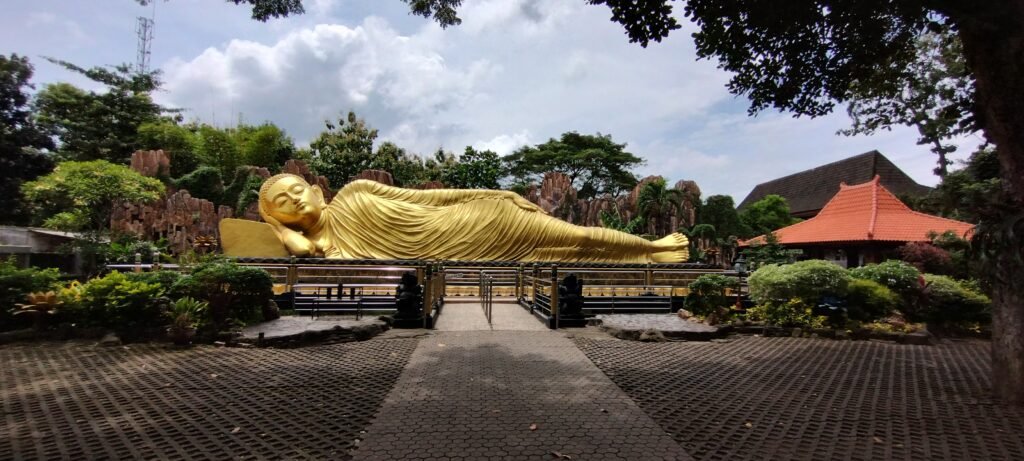
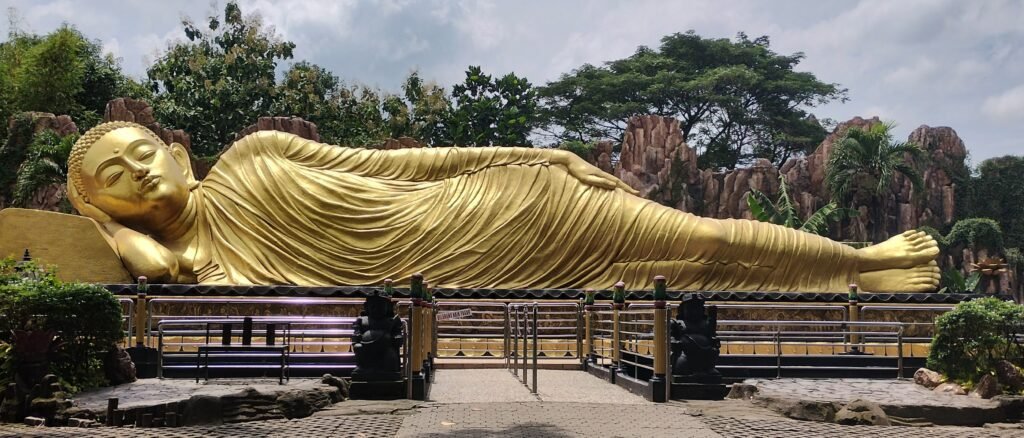
Resting in the backyard of Maha Vihara Mojopahit is an enormous, 22-metre golden statue. This is the reclining Buddha, or Buddha Tidur, who does not lie at the centre of the site but to the side. In keeping with the Buddha’s humility, the statue does not seek attention but instead signals to those drawn to its presence.
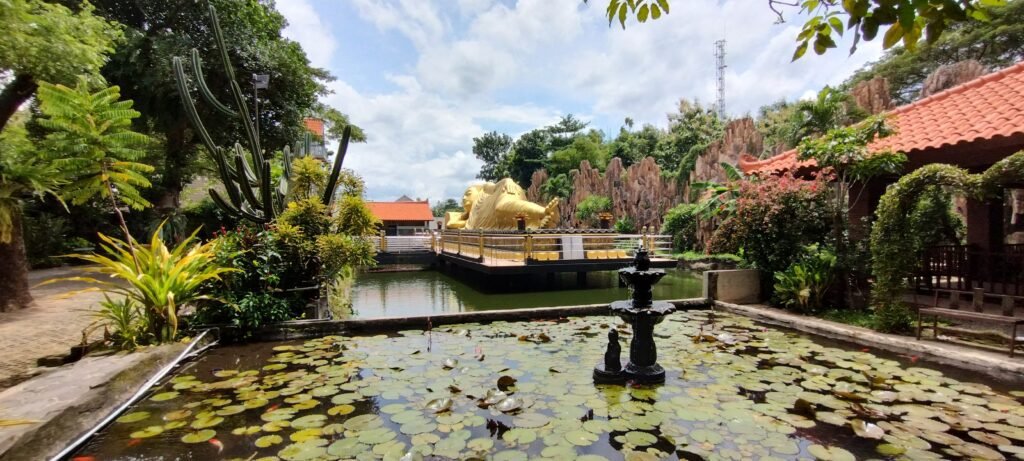
The reclining Buddha, with its huge golden body, stretches across half the courtyard’s breadth. It rests on a simple plinth next to a fish pond, which symbolises the ocean where Gautama Buddha’s ashes floated after his passing. Water lilies and lotus flowers float on the water’s surface, and around the plinth run stone reliefs that show the Buddha’s life and rebirth.
Behind the Buddha is a simple backdrop of trees and stones. The statue and the sky have equal footing. The former embodies wisdom and mercy, while the latter conveys infinity, wherein the Buddha’s teachings fill the largest vessels as much as the smallest,.
Some say the statue, with its body facing south and its head resting on a pillow supported by its right arm, shows the Buddha had attained the highest level of nirvana. This was his posture when he left the world. Another, more pragmatic, view posits that the Buddha, still earthbound, is meditating, and this is the pose he takes.
Master craft
Buddha Tidur was built in 1993 by YM Viryanadi Maha Tera, a craftsman from Trowulan. At 22 metres long, 6 metres across and 4.5 metres high, the statue is Indonesia’s largest of its kind. It surpasses similar figures in Batu, Bogor, Jakarta and Semarang. Although Mojokerto may not have the clout of these places, the version at Maha Vihara Mojopahit springs to mind more quickly than others across the region.
The Buddha has a sensible size. It is large enough to command attention, but not so big that it defies understanding. The statue teaches a lesson in dissolution. In its stillness, it compels the viewer to untether their ego and see that, for the most part, their problems and anxieties don’t mean that much. Rather, a minor sense of awe descends that, expanding, inhabits such a large space that the beholder dissolves into a stream of peace and reverence.
Sitting before the reclining Buddha is a hypnotic undertaking that involves both doing and undoing. It inspires daydreams, and some people claim to have lost hours staring at the statue; when they return to their body, they realise their absence has not created so much as a ripple.
Equally, in trying to recall what went through their mind, they can only picture a grey blankness. If only they had looked closer, they would have seen that the space comprised countless granular permutations of thought, locked and linked together like chainmail, and pulsing as though blood coursed through them.
Land of the living
Oftentimes, the smell of refreshments entices them back to the waking world. There they sit and wonder if their daydream has ended. But then again, the notion of a cup of noodles and a kretek cigarette, washed down with a kopi susu, is equally as enticing.
Afterwards, questions arise over the Buddhist notion of overcoming craving. Training one’s mind to navigate the impermanence of desire seems like a sensible idea. Perhaps, though, it shouldn’t be done so on an empty stomach and without a hit of nicotine. The reclining Buddha, still at rest, where it will remain until time itself dissolves, gives no hint as to its feelings on the subject.

Things to know
Lokasi
- Gg. I, Siti Inggil, Bejijong, Kec. Trowulan, Kabupaten Mojokerto, Jawa Timur 61362, Indonesia
- Latitude: -7.55552° (7° 33′ 20″ South) / Longitude: 112.3701° (112° 22′ 12″ East)
Accommodation
- Mojokerto Classic Homestay [Jl. Jayanegara; approx. £7 / 170,000 IDR for a double room, ensuite, Wi-Fi] worked for us. The homestay was well-placed for walking around, including a very enjoyable stroll to the alun-alun via a couple of kampungs and green spaces, and just out of the way of the main action and noise
- Decent bakso joint just next door, too
Getting there and away
- A bus from Surabaya’s Terminal Bungurasih dropped us at Terminal Kertajaya in Mojokerto. Plan for about an hour’s journey, with tickets costing from 9,000 IDR to 20,000 IDR
- To reach Trowulan from Mojokerto, it’s probably best to book transport using Grab or Gojek. Failing that, most ojek drivers will probably be willing to go there, since Trowulan is a well-known site and there’s plenty of scope for customers. It’s about 20 minutes, door to door
- The temple is a little out the way, so visitors will need transport to get there, unless they wandered down from Candi Brahu. We used an ojek from the Majapahit Museum (which, it turns out, is opposite Kolam Sergan) on Jl. Brawijaya, and that took about 10 minutes
- Returning to Mojokerto meant taking another ojek via Grab, this time from Indomaret Trowulan 98 on the main road, where Jl. Candi Brahu meets Jl. Totok Kerot. Allow for 20 or so minutes, depending on traffic
- This Indomaret was the nearest visible landmark and an easy place to meet the driver
- As of October 2026, with large parts of Kalimantan on fire and the fuel crisis consuming various parts of the archipelago, try not to get too wound up if organising a ride proves to be a bit tricky
Read More: Lake Sarangan Lore: Dragons, Eggs and Enchantment in East Java
Discover more from Eye in the Middle
Subscribe to get the latest posts sent to your email.