This page has affiliate links. If you click and buy something, EitM might earn a small commission, at no extra cost to you, the reader. As always, thanks for reading.
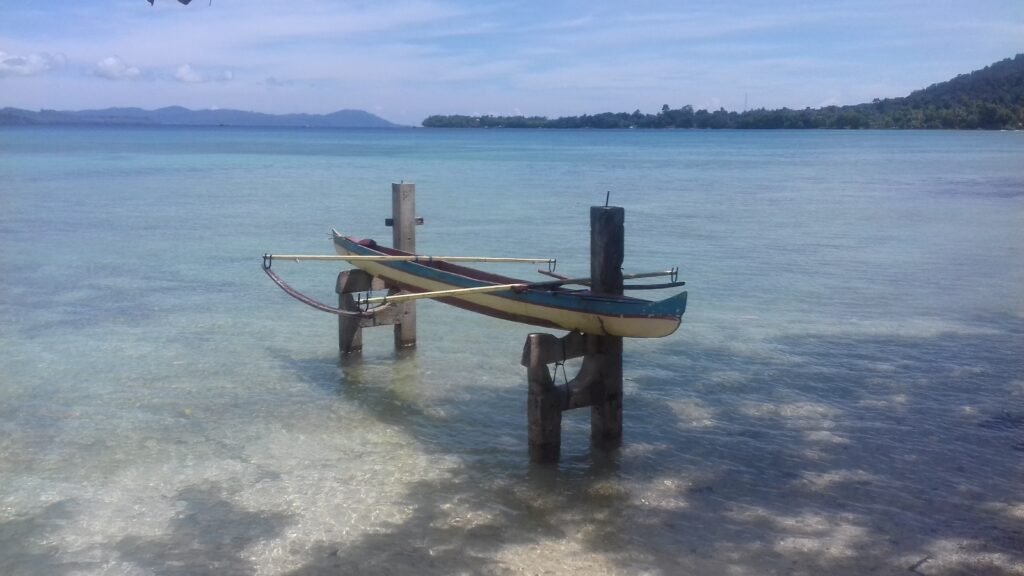
Pulau Saparua: Tracing the Roots of Conflict in South Maluku
Just off the coast of Ambon lies an unassuming island known as Pulau Saparua. But can the same be said when a visitor gets to know this corner of Indonesia?
(2026 reassessment: The story’s fine, but also clunky and wordy, and it rambles on a bit. It’s undergone some pretty sizable edits to improve tone and clarity, and remove some of the smugger, very bad phrasing. The ending’s a bit sudden, we think, but overall, the whole thing reads OK. Decent but not definitive, we’d say.)
There are many beautiful islands in Indonesia, and each has its own distinct shape. Many have commented on the distinct form of Sulawesi, for instance, which has a chitinous border that brings to mind the fever dream rendering of a turtle infected by cordyceps. The aggressive outline, though, does not disguise that the region has many pretty places to see, plenty of graceful, vibrant traditions, and a thriving culture.
Further east, Maluku has less of an intense shape. Thinner and less jagged than its western neighbour, the region is nevertheless home to an equally beguiling mix of beauty, tradition and history, that reaches all the way from Sopi in the north to the Banda Islands in the south.
One of the most intriguing places is Pulau Saparua, which bears the graceful shape of a butterfly. And although the island is as active and busy as its neighbours, from a tourism perspective, it lies dormant, and very much on the outskirts of interest.

Saparua is one of the Lease [lay-a-say] Islands. Its siblings in this chain comprise Haruku, Saparua Timur and Nusa Laut. A visitor heading east from Tulehu port in Ambon can reach Pulau Saparua singular in around an hour or so by sea.
Many arrivals dock at the coastal village of Haria, and proceed across the island by motorbike. On their way, they pass beaches and coral reefs, each made pretty by clear blue water.
The open roads and expansive countryside creates a feeling of excitement, that reflects the sense of having reached a place somewhat less well-known than others in Indonesia. There is also a thrilling buzz, of the kind that comes from not knowing what to expect.
And each step across the island brings an unexpected thing: an abandoned dive centre, perhaps on Jl. Raya Saparua-Nolot; a magnificent gereja, or church, in the same area; a remote stretch of beach at Pantai Potalae Paperu.
Read More: Boeung Kak: The Sad Loss of Phnom Penh’s Lakeside
First impressions of Pulau Saparua
Eventually, many visitors reach Kota Saparua, the island’s capital. It is easy to call this place ‘sleepy’ thanks to an easy pace and lack of surface noise. But like many centres, Kota comes to life on market days. Sellers and buyers from across the four islands descend upon the marketplace, where fresh and smoked fish, in particular, encourage a roaring trade.
Looking further afield, there is Booi, a district with many farms, and reachable only by a large staircase. To the southeast lies the village of Ouw, where artisans make fine pottery by hand. Ouw also has a resident fort, now semi-overgrown and claimed by villagers as their home.

But it is only when settling on Kota Saparua that the true weight of history becomes clear. Skirting around the bay, that has clear views to Nusa Laut, and passing by a sports field that sits under the auspices of the tower-like Pattimura Monument, the visitor will find, on the water’s edge, a historic Dutch fort called Benteng Duurstede. More will be made of this site later.
Further research will reveal that Maluku suffered political unrest in 1999. This chaos quickly escalated and became violent. The ensuing bedlam cast a drape over this corner of Indonesia and left it very much isolated, certainly from a tourism perspective, for a good many years.
The roots of the conflict run deep. For now, it is worth understanding the constituent parts of Pulau Saparua, an island of 17 villages and around 35,000 residents. The prominence of churches indicates that this is a mainly Christian island, but the smattering of masjids shows that Islam, too, has a presence.
There are many cases across Indonesia of the followers of different beliefs living side by side. In Maluku, the Pela Gandong system crosses religious and social rifts. It is a bond that calls for unity between communities, and takes many forms, such as sharing resources and providing mutual aid. Pela Gandong teaches tolerance and provides a framework for healing divides and keeping the peace.
Read More: Hoàn Kiếm Lake: The Heart of Hanoi’s History
Clashes in Maluku
External pressures, though, can cause enormous fractures that slice apart harmonious bonds. Such a tragedy occurred in Maluku at the end of the twentieth century, when sectarian violence claimed 5,000 lives. This conflict, from 1999 to 2002, drew a marked religious divide and spread over Ambon and Halmahera.
At the time, Indonesia struggled with economic and political instability. The value of the Rupiah fell sharply after the fall of Suharto, compounded by the wider financial crisis in Southeast Asia. And the archipelago’s regions faced great change as well.
The province of Maluku was about to split into Maluku and North Maluku, which heightened extant political discord. And since this friction had a religious aspect, fighting soon broke out between Christian and Muslim communities. Indonesian government forces stepped in to quell the violence, to little effect.
On 19 January 1999, there was a flashpoint in Ambon. A Christian minivan driver and a Muslim youth became embroiled in an argument over money. The tension, already made febrile by social and economic instability, escalated and quickly grew out of control. Soon enough, hostilities spread through Maluku, with much loss of life and reports of forced conversion and forced circumcision. Rioting, mass displacement and wanton destruction had become commonplace.
By June of that year, many people had died on Pulau Saparua: one clash between Christian and Muslim youths in Sirisori left around ten fighters dead, and in the same village, six died after a row over damaged clove plants became violent.
Officially, the signing of the Malino II Accord on 13 February 2002 brought the fighting to an end. But the agreement was more of a truce, and it was months before peace gained a secure footing. On Pulau Saparua, as in many places, informal boundaries partitioned Christian and Muslim communities. Reconciliation has been a slow process, and it still continues today. The trauma of the conflict runs deep, but through the efforts of the Malukan people and Pela Gendong’s emphasis on cooperation, the sense of fragile peace has grown gradually stronger.

Pulau Saparua and the spice trade
As devastating as the 1999 conflict was, it was not the first time that Saparua had become entangled in violence. The island has legacy of resistance that stretches back centuries, and encompasses European involvement in the spice trade from the early 1500s to the early 1800s. At the time, Malukan spice like cloves and nutmegs commanded a high price on the global market. The region gained so much renown that for a while, the nearby Banda islands were more valuable than Manhattan.
Colonisers take advantage
The Portuguese seized Maluku in 1511 and established a presence there, initially in the north of the region. Explorers landed to the south, in Ambon, the year after, and by 1521, they had set up a factory there to collect cloves, which gave them a stronghold in the lucrative spice market. The colonisers strengthened this claim through an alliance with the Sultan of Ternate in 1522.
But the Portuguese could not establish a lasting peace. They faced frequent attacks from Muslim communities, culminating in 1570 in a region-wide anti-Portuguese holy war after the assassination of Sultan Khairun of Ternate by a Portuguese captain. By 1575, the colonists were defeated and expelled from North Maluku. They shifted their efforts to Ambon, where they established the stronghold of Fortaleza Nossa Senhora da Anunciada in 1576.
In 1578, the Portuguese tried to reestablish their footing in the north, building a new fort on Pulau Tidore. But they never held the same influence, and by the time the first Dutch merchant fleets arrived in 1599, anti-Portuguese sentiment was strong. The newcomers quickly forged treaties with the Muslim rulers. In 1605, the Dutch ousted the depleted Portuguese without a fight and claimed the fort in Ambon for themselves.
The Dutch take control
The Dutch, having come to colonial power, took control of the spice trade around the Lease Islands. Their monopoly was strict and enforced with violence. Between the 1620s and 1650s, they carried out a series of naval raids, the Hongi expeditions, that targeted threats to the Dutch East India Company’s (VOC) control of the spice trade. The attacks were designed to maintain Dutch control of the produce and keep prices artificially high in Europe.
The VOC dictated who could grow spices, and where. To keep the trade exclusive, they limited clove production to Ambon and the Lease Islands. Anyone who grew clove trees outside of these zones or exceeded their quota faced retribution from the Dutch. The Hongi fleets would go after ‘unauthorised’ plantations, destroying or burning them, and starving whole villages into obedience.
Before the Dutch arrival, Malukans traditionally traded freely with Asian merchants. But after the VOC took power, they deemed this trade illegal. To reinforce this diktat, the Hongi expeditions violently suppressed anyone who bypassed the Dutch and sold their cloves clandestinely. Smugglers caught by the Hongi faced enslavement, execution or imprisonment. The secret trade network encompassed Javanese, Malay and Arab-Persian merchants, amongst others. These traders paid higher prices for the cloves than the low rates enforced by the VOC.
Rival European powers fared no better. British, Spanish and Portuguese merchants who bought cloves from Malukans may well find a Hongi patrol on their tails, with orders to attack the offending vessel, seize their cargos and arrest their crews.
Show of power
In 1691, the Dutch looked to consolidate their position. In a show of strength, and to ensure their presence was always noticed, the VOC constructed Fort Duurstede, or Benteng Duurstede, on the southern coast of Pulau Saparua. The fort was built on a limestone peninsula and still stands today, a martial husk on the waterfront that, from above, looks like a diamond with rounded fringes. Duurstede served as a military HQ, prison and residential palace for the Dutch colonial administration.
For the next century, the Dutch remained firmly in power on Saparua. During that time, the VOC established their monopoly, and the island entered into a phase of strict control. Neither foreign incursion nor Malukan rebellion weakened their grasp on the island.
Inwardly, however, the VOC struggled. Corruption, smuggling and surging costs rotted the organisation from within. The diluted company became an isolated shell. It lost its power and its resources, meaning outposts like Saparua received no salaries or supplies.
Back in Europe, the French Revolution and the fallout of the Napoleonic Wars saw the Dutch government collapse. This weakness quickly spread to the colonial governors. In 1795, they were ordered by the exiled Prince William V to hand over their territories to the British, to avoid these resources falling into the hands of the French.

Seized by the British
Thus weakened, the VOC put up no fight when the British military seized Maluku, including Saparua, from the Dutch in 1796. For the next few years, the region was comparatively calm. The new colonial powers proved more lenient than their predecessors. They respected regional leadership, integrated Malukans into their armed forces and paid fair rates for spices. The corrupt, broken and penniless VOC, meanwhile, was dissolved in 1800.
The British stayed in power until 1803. A peace treaty in Europe saw them briefly return control to the Dutch. But by 1810, the Napoleonic Wars resumed, and the British reassumed control of Pulau Saparua. They stayed in power until 1816, when Napoleon was defeated. The ensuing political merry-go-round in Europe saw the British, looking to safeguard their resources and manpower, hand Maluku back to the Dutch.
Read More: Deathless Light: Wisata Api Abadi in Pamekasan, Madura

Pattimura
Back in power, the Dutch failed to heed the lessons of British rule. Instead, the new Dutch governor on Saparua, Johannes Rudolph van den Berg, re-imposed strict corporate monopolies, drastically cut wages in the region, and refused to pay Malukan soldiers who had served in the British military.
Malukan efforts to diplomatically resolve this harsh treatment received only threats of violence. Peaceful mediation failed, forcing the figureheads of Christian and Muslim communities, alongside frustrated ex-soldiers, to find another solution. Meeting in secret at Gunung Saniri, or Mount Saniri, in the green heartland of Saparua, they agreed upon a plan of action: rebellion.
The Malukans chose Thomas Matulessy as the leader of their revolt. He was born on Seram in 1783 and in 1810, enlisted in the British Colonial Auxiliary Forces after they claimed Maluku from the Dutch. Matulessy had a distinguished career as part of the British Amboina Corps, or Ambonese Corps. His tactical acumen and leadership saw him rise to the position of Sergeant Major.
Rising rebellion
Matulessy stayed in British employ until 1816, when they returned the region to the Dutch. The transition, however, was not peaceful, and succeeded only in undoing the leniency of British rule. Soon enough, the Dutch discharged Matulessy and his fellow soldiers. The colonists also enforced military conscription that targeted the young men around Saparua and the wider Ambon region. This decision bred panic and resentment amongst the Malukans, which grew when it was discovered that the conscripts would be sent to Java, to protect Dutch colonial interests.
Tension had already festered thanks to the colonists’ decree to stop paying Indonesian Christian teachers. This lack of respect for the pious angered Matulessy: the planned switch to paper currency – rather than coins – would mean the Malukans could not give alms. And in turn, the church could not help the poor.
Against this background of frustration and colonial intrusion, Matulessy accepted the position of supreme war commander on 14 May 1817. With his rank came the title Kapitan Pattimura, which translated to ‘The King of Justice’. Pattimura came to embody the spirit of resistance that grew across Maluku.
The Saparua rebels made their move the next day. Thousands of fighters, led by Pattimura and his lieutenants, came down from Saniri and surrounded Duurstede. The next morning, the rebels stormed the fort. It was an intense assault that saw Pattimura and the rebels breach the walls and take Duurstede.
The storming came at a cost. Nineteen Dutch soldiers died in the fighting. So, too, did Resident van den Berg, his wife and two of his children. The sole family survivor was Jean Lubbert, van den Berg’s infant son. Pattimura ordered that the child, who was injured during the fighting, be protected. And afterwards, the newly-orphaned youngster was taken in by villagers on Saparua, who nursed him back to health.
Back on the mainland, the Dutch authorities panicked. They had lost their symbol of rule on Saparua. In retaliation, they sent an expedition, 200-strong, of elite fighters led by Major Beetjes. But the reinforcements did not get far, ambushed and overwhelmed on the beach by the rebels.
Call for independence
At the end of May, Pattimura issued the Haria Proclamation. This official manifesto was launched in Haria, on the southwest corner of Saparua. It asserted Malukan independence from the Dutch and listed grievances against the colonisers, including economic abuse linked to the spice trade.
The proclamation declared Pattimura leader of the Malukan people. In its wake, a wave of anti-colonial sentiment spread across Maluku. Dutch forts were waylaid on Nusa Laut and Haruku, while on Hitu and Seram, Christians and Muslims, bound together by Pela Gandong, fought the colonisers with such ferocity that they retreated behind the thick walls of their forts. Dutch outposts were even targeted in North Maluku.
The rebels held Duurstede until 3 August 1817. They saw off wave after wave of Dutch attacks. It took the concerted effort of an enormous counter-offensive, coordinated from Batavia in Java, for the Dutch to reclaim the fort. Pattimura and the rebels retreated to Saparua’s forests. They held out for a few more months, waging a guerrilla campaign against the Dutch
Eventually, however, the colonists caught up with the rebels. The end came in the form of a betrayal, driven by revenge and jealousy. The agent of this treachery was Pati Akoon, the King of Booi. He felt affronted that Pattimura had so much authority, at the expense, he thought, of regional authority, including his own.
One day, in November 1817, Pattimura and his fighters took refuge on the south coast of Sapurua. This was Pati Akoon’s territory. He leaked the rebels’ whereabouts to the Dutch, and also their tactics, so that the colonists had a way to counter-strike. On 11 November, troops ambushed and captured the resting rebels.
They were taken to Ambon and tried. The authorities, pride wounded, sought to reassert their weakened power. They made Pattimura an offer: sign an agreement recognising Dutch rule, and his life would be spared. The Kapitan refused, condemning the insurgents to death. On 16 December, Pattimura and his closest fighters were hanged outside Fort Victoria in Ambon.
Legacy remains
Today, Pattimura is honoured as a symbol of Malukan independence and Indonesian patriotism. In 1973, President Suharto declared Pattimura a national hero. The Kapitan gained recognition for his courage and tenacity, and his name lives on across Indonesia. Visitors to many places in the archipelago may note that streets bear Pattimura’s name, as do the university and airport in Ambon. Many celebrate 15 May as Pattimura Day in the Kapitan’s honour, and his visage appears on the 1,000 rupiah banknote.
Thomas Matulessy left behind him a lasting legacy, forged in the forests and heartlands of Pulau Saparua.
(Honest Editor: See? Extremely quick ending.)

Pulau Saparua: Things to know
Where to stay
- Whilst Penginapan Mandiri had a nice setting on the harbour in Kota Saparua, a jetty that overlooks the ocean, easy access to the marketplace, an inviting yellow facade and basic but functional rooms [think DIY bak mandi], we suggest watching out for twothings
- The first was the treatment of trash and recycling. Each day, the staff would empty the bins of any recently vacated rooms and place the trash in a single binliner, which they then placed on the jetty. We watched this unfold, wondering, whilst knowing deep down what was coming, what would happen with the trash. We were correct: the bag was emptied over the side into the ocean. When we looked over the edge, many months worth of rubbish had congealed together, held strong by some sort of gloop of an unnatural green colour. The staff didn’t seem mean-spirited in this habit, and trash is a problem in all places, but we could see why people could find it upsetting
- The second came in the form of a lesson: don’t leave your valuables within eyeshot of an easily-openable window. We left some rupiah on a bedside table, popped downstairs for a moment and when we came back, the money had gone. The window by the table was open, clearly slid open from the outside. Whilst we don’t want to point the finger of blame, a hanger-on of the staff quickly disappeared from the hotel, smiling at us as he walked past, as soon as we came out of the room. Naturally, we never saw this person again, and our Indonesian language skills were, at the time, not strong enough to fully follow it up with the staff, who didn’t seem that concerned. We chalked the affair up to experience and got on with our day
- Do your research before committing to a stay here, is what we’re saying
Getting there and away
- Most boats depart from Ambon for Saparua from Tulehu to Haria. EitM took a charted speedboat, on account of the planned ferry not showing up. The crossing cost 100,000 IDR, but the price didn’t feel consistent, and that different operators would charge different amounts. Trips typically take place at 9 am and take up to an hour; it requires going past Pulau Haruku, which takes a bit of time
- Return trips from Saparau start at 6.30 am. We took a ferry from Kulur to Waai, and it took a couple of hours, at a cost of approx. 25,OOO IDR
- Tulehu is about an hour east of Ambon; Ambon is a hub or the area, and boats and flights arrive there daily from all over Indonesia
Discover more from Eye in the Middle
Subscribe to get the latest posts sent to your email.