This page has affiliate links. If you click and buy something, EitM might earn a small commission, at no extra cost to you, the reader. As always, thanks for reading.
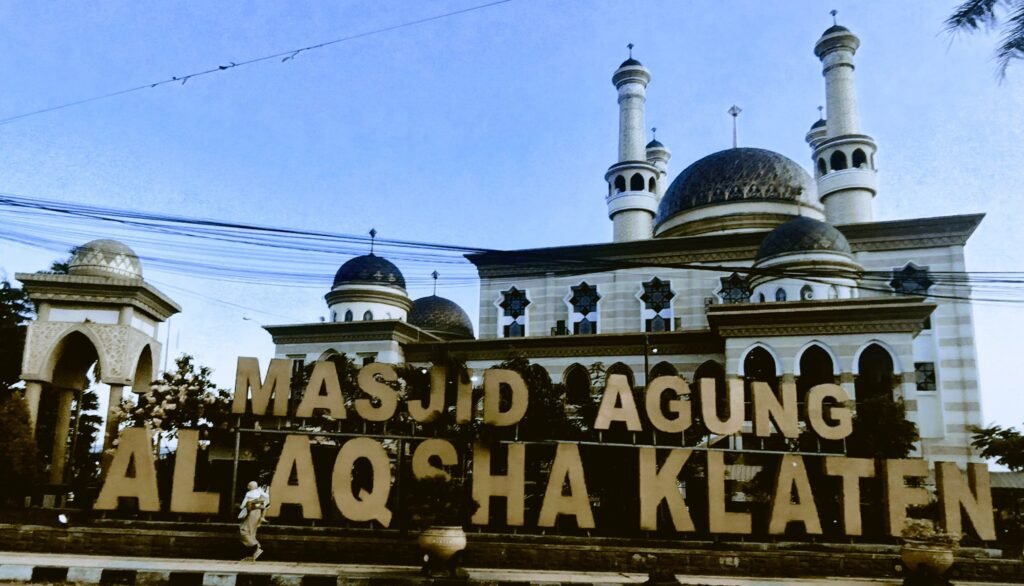
Al-Aqsa Grand Mosque: A Place of Worship in Klaten
There are many tendrils that snap back and forth through time and shape all that encounters them. These tendrils stem from the same source that none have ever seen, and they go by many names.
One such stem called itself Worship. Worship showed a remarkable tenacity for ensnaring all manner of things within its grasp. One strand, that did name itself Islam, fell upon a vast archipelago. There, in a place that others had designated Indonesia, it gave its voice to those that would spread the strand’s message throughout the land.
2026 update: Bit pretentious, this one. Nice idea and some decent phrasing, but a bit too chin-stroking. The actual information itself is all genuine and, hopefully, helpful in some ill-defined way
And one day, Islam did find its way to the centre of Java, the largest of all Indonesia’s many islands. There it enjoyed sway over the heartland. No more so than in Klaten. Here, the followers of Islam felt compelled to build structures. In these places, they may laud the sacred words passed down to them and abide by their teachings.
Now, in Klaten, one may find many buildings that give shape and form to the different forms of Worship. Some say that they have spoken with Worship and that Worship has showered them with kind words and lessons to ponder.
And in these places, the devout and the divine may pray. The followers of Islam named their structures masjids or mosques. They constructed a great many across Indonesia.
An observer who chooses to stay in Klaten may know a masjid or mosque by its columns and ornate roofs, splendid domes covered with intricate tile designs.
And if one does not comprehend such a building when they see it, the noise that issues forth will leave no witness in confusion. Five times a day, one may hear the call to prayer from the tall, thin minaret towers that fortify the bulkier main building. These tell all adherents that the time for Worship is at hand.
Place to pray
Klaten is no exception. A worshipper may take their pick from many options to prostrate themselves. But none is more grand than the youngest of these scions of Islam. The town leaders named it Al-Aqsa Grand Mosque (a name shared by Islam’s third holiest site, found in Jerusalem). It offered sufficient space for 3,000 people.
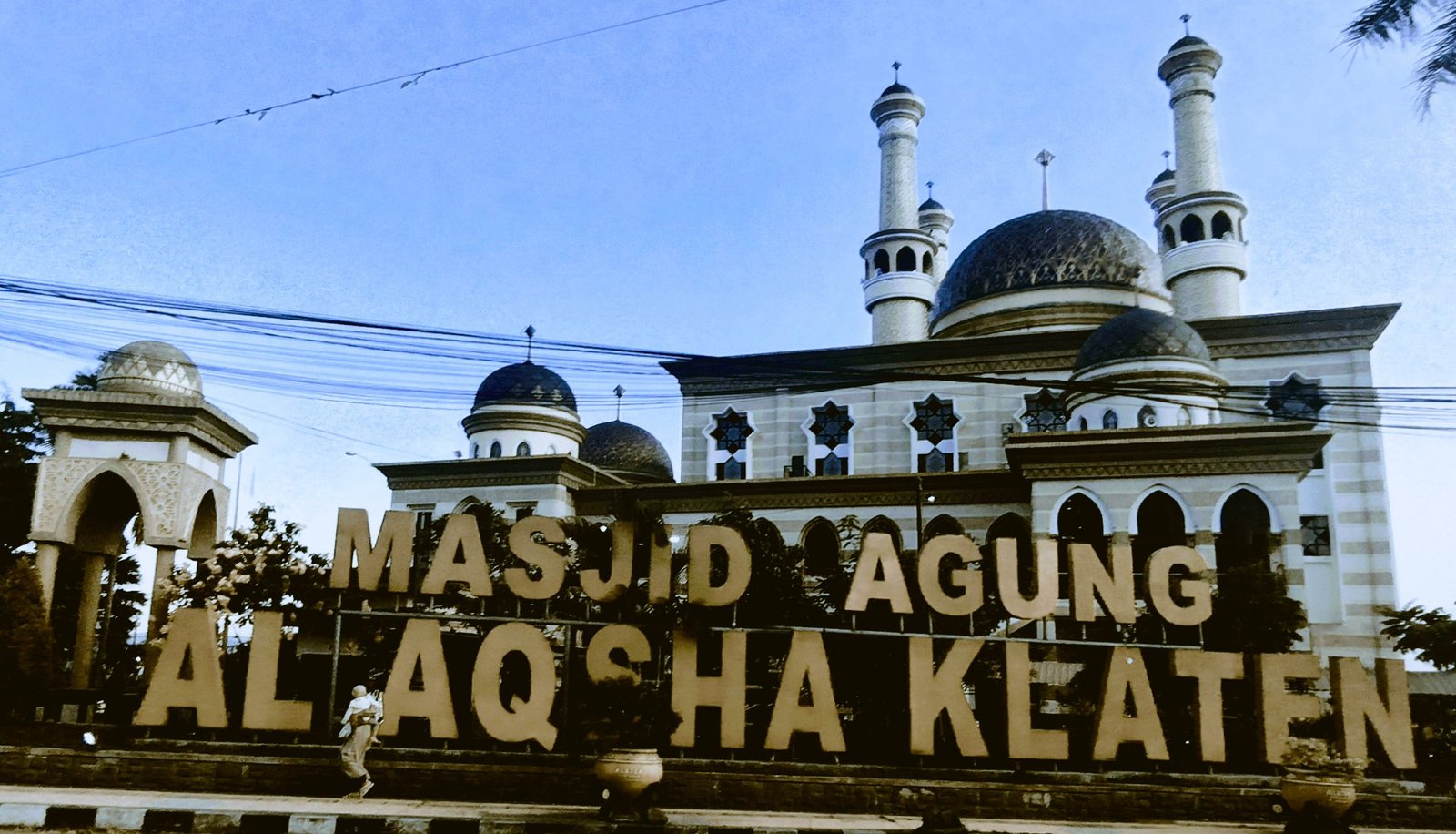
Construction of Al-Aqsa, which covers over 5,000 square metres on the Solo-Jogja road, began in 2012. The inauguration followed in 2015, during the regency of Sri Hartini; the first Friday prayer and Eid ul-Fitri occurred on June 3, 2016.
The site’s main bulk had a former life as a bus terminal, while the parking area once housed three public high school buildings. The loss of these edifices caused some controversy with little sufficient resolution, save that one mode of instruction made way for another.
Some have questioned Al-Aqsa’s location, for it stands some way from the centre of Klaten. Cynical voices have wondered aloud whether such a position had catchment areas in mind to entice passing travellers. These same people may avail themselves of the mosque’s facilities.
Read more: Wondering how the city of Surabaya acquired its name? Perhaps this might help explain
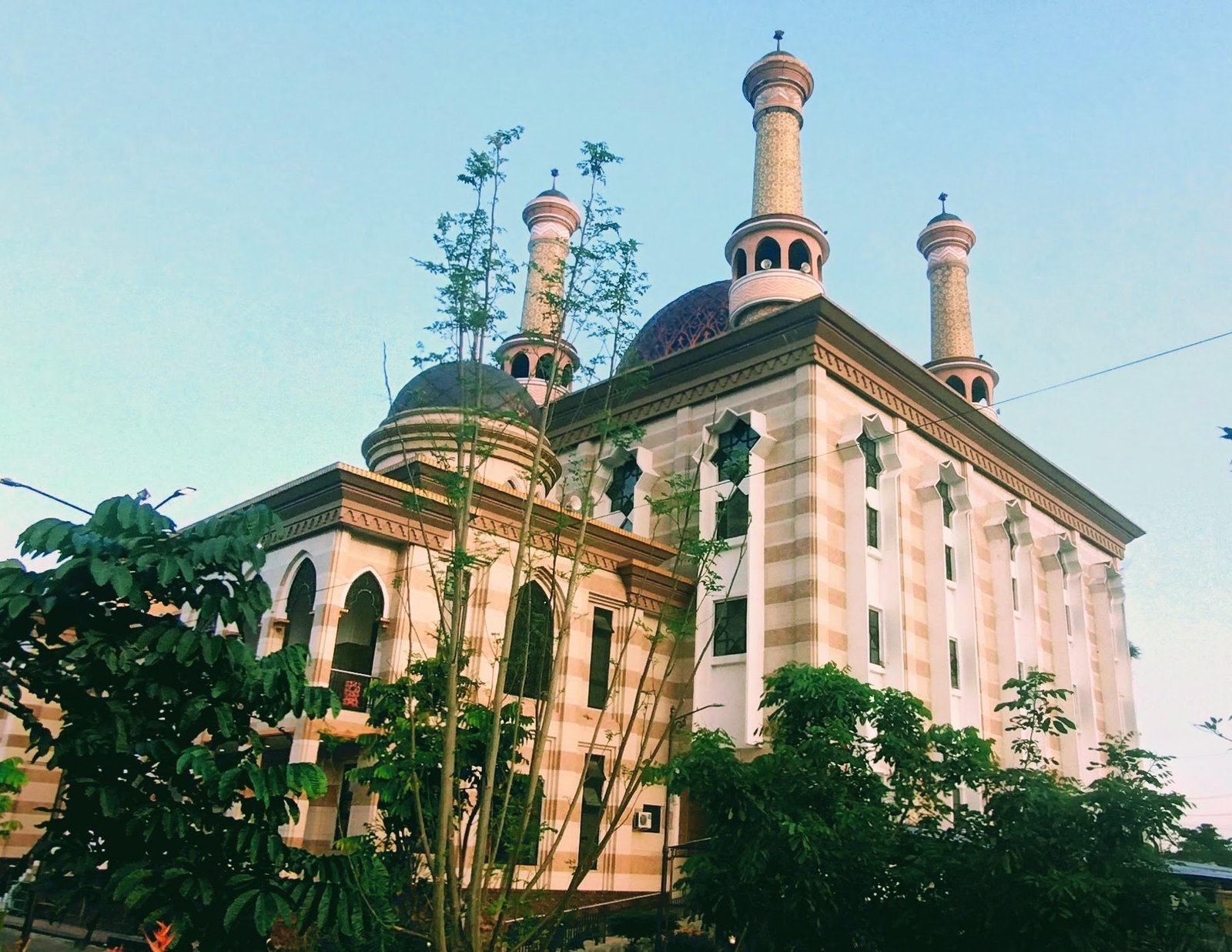
And as worshippers step through the threshold to the interior, they may take some time to process the Al-Aqsa’s splendid shell. They may see a trio of intricate copper-domed roofs, flanked by a guard of minaret towers, atop a body buttressed by a quartet of columns.
The building’s tone seems to shift like the sands, changing from ecru to beige to purple as it attracts the rays of the dying light. The fronds of date palms play in the air as the breeze passes over the attendant courtyard.
Distinct look
But once inside, one may find their attention diverted by the Middle Eastern-style architecture. Slowly, crisply and with the control of one who knows that theirs is the beatific.
All nooks and all crannies bear a tattoo of tiny, delicate markings to strike a similarly grand chord. But even this beauty pales next to the main door. This slab of golden yellow iron adorned with verses from the Quran shimmers with a stately dignity. It sends a divine charge amongst all who may pass in wonder through it.
From there, one may walk around the three floors of Al-Aqsa. Those in search of Worship may find themselves drawn to the main room on the second floor. They should take the stairs designated to their gender, for convention dictates that men and women use different staircases in places of religious practice.
And commanding one’s view is the Mihrab: a ten-metre high niche in the wall marked with golden Arabic calligraphy and coverings of Al-Fatihah and Al-Isra. The devout will know that the mihrab indicates the qibla, the direction Muslims should face when praying towards the Kaaba in Mecca. ‘Twas ever thus for the decrees set forth by Worship.
And upon the third floor, one may find much the same splendour. An inner dome adorned with Middle Eastern decorations rests above space for the overflow of pilgrims if the second floor should prove too full.
Here the atmosphere of Al-Aqsa is given full reign to shine. It does so through windows of yellowish-tinted glass that invite the light to permeate the mosque and serenely shine on the interior, like the rays of the sun shining upon all that is sublime and holy.
Things to know
Accommodation
- Hotel Alami [Jl. Sulawesi; approx. £5 / 120,000 IDR for double room, ensuite, WiFi] suited our budget needs. Big rooms, access to an ashtray and somewhere to sit, Indomaret close by, bakso place in walking distance. All fine. The alun alun is a 5-minute walk away
- Heads-up: If there’s an event on at the alun alun, the roads in the area get super-busy and the crowds grow tremendously large, including outside the hotel. The buzz and the excitement are palpable, and it’s also true that there are many people and it gets noisy, so the claustrophobic, agoraphobic or crowd-wary visitor might want to consider somewhere less central
Getting there and away
- Klaten is pretty much midway between Yogyakarta and Solo/Surakarta
- A bus from Solo costs between 15,000 IDR [budget] and 60,000 IDR [executif / VIP]. Presumably the cost is similar coming from Yogya
- Allow for a couple of hours
- A bus from Solo costs between 15,000 IDR [budget] and 60,000 IDR [executif / VIP]. Presumably the cost is similar coming from Yogya
- The mosque is on Jl. Klaten – Solo / Jl. Veteran, right next to the main road. It’s easily walkable, if a touch noisy due to the traffic, and we imagine that every Grab, Gojek, ojek, becak and bemo driver will know where it is
- We walked the long way round via Hutan Kota Gergunung, or Gergunung City Forest [Jl. Ki Ageng Gribig]. It’s a nice and green urban park with dove houses, statues, artwork and replicas of landmarks, and a good place to escape the fumes and drone of the kota itself
- We walked the long way round via Hutan Kota Gergunung, or Gergunung City Forest [Jl. Ki Ageng Gribig]. It’s a nice and green urban park with dove houses, statues, artwork and replicas of landmarks, and a good place to escape the fumes and drone of the kota itself
Discover more from Eye in the Middle
Subscribe to get the latest posts sent to your email.