This page has affiliate links. If you click and buy something, EitM might earn a small commission, at no extra cost to you, the reader. As always, thanks for reading.
Reog Ponorogo: The Dance of Resistance in Java
At some point, a visitor to East Java hugging the southern coast will alight in Ponorogo. The regency lies on the border of Central Java in Indonesia, and it has much to interest those who seek Javanese culture and heritage. And nothing illustrates this deep-rooted tradition more than Reog Ponorogo.
Kota Ponorogo’s alun-alun gives some indication of this depth. Open and square, this space sits at the city’s heart and directs life like a pulmonary system. All things, traffic and people centre on Ponorogo’s alun-alun. But even if the visitor did not know where they stood, it should become clear that they have found a place of rare culture.
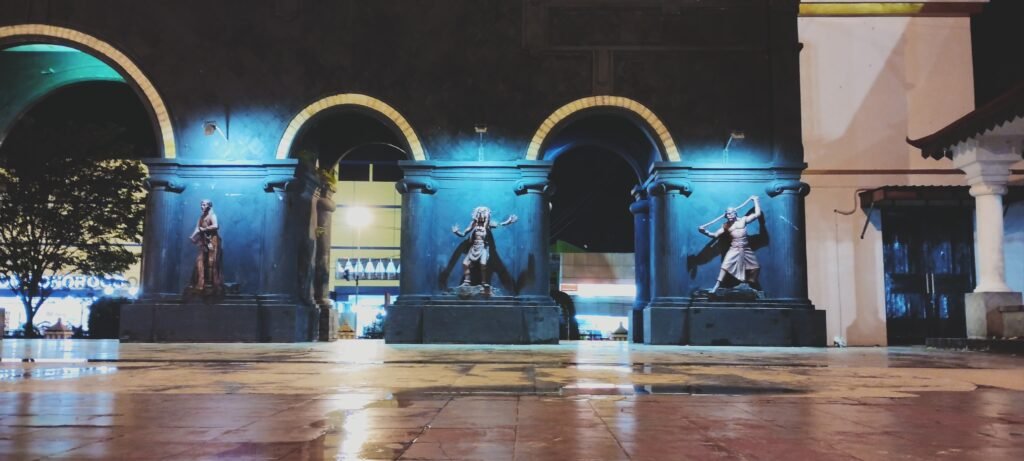
A walk around the square creates some fanciful notions in the visitor’s brain. At one end of the alun-alun, they see on the stage a line-up of statues locked in graceful poses. And at the other end, they pass a giant lion as handsome as David and dark as obsidian rock.
The effect begins subliminally, as though the mind can only slowly process what it absorbs. But soon, indelible ideas take root. A glimpse of peacock feathers. Giant faces, wildly out of proportion with their bodies. Images of felines rendered square and slab-like. Heraldic poses that convey pageantry and, to the unaware, hint at mystery.
Reog Ponorogo: Dance and Soul
And like the rising sun, it soon dawns that a unique charge pulses through Ponorogo, that something has found form there. The visitor, having decided to stay in Ponorogo, soon learns the force’s name, for people make no secret of its importance to Ponorogo. They call it Reog, the traditional dance coloured by twists of magic.
And at once, Reog’s reach becomes clear. The place and the dance have merged. Ponorogo is the home of Reog, and Reog took shape in Ponorogo. And that comes before one notices the props and statues that dot the landscape like a map leading to some cultural hinterland.
Those who spend enough time in Ponorogo will note Reog’s presence at any cultural waypoint. They may feel its presence on the Islamic holiday of Eid al-Fitr. Or they may hear its call during the Independence Day carnival, on 17 August. Most will find it at the Grebeg Suro party to honour the culture, tradition, heritage and essence of Ponorogo. And those who miss such things can always watch one of the regular showings at Ponorogo alun-alun’s Paseban pavilion [Jl. Jenderal Sudirman]. All around, one may breathe Reog.
- 2026 update: There’s a Reog festival in Ponorogo at the Paseban pavilion in June 2026. The Festival Nasional Reog Ponorogo (XXXI) & Grebeg Suro runs from June 11 to 14 and promises nightly performances. It runs in conjunction with the Islamic New Year, so the mood will probably be one of high celebration, with much stimulation, sound and general well-wishing. We certainly foresee that the peacock feathers atop Singo Barong will rustle with just a little more verve than usual around this time.
- Accommodation will probably be at a premium, too, so it might be worth pre-booking somewhere. RedDoorz Syariah at Aura Homestay was fine for us, working on a budget: clean, safe and cozy, with lots of tips from the staff on what to do, where to go and where to eat
- NB: This is a Syariah-compliant homestay that caters mainly for Muslim guests, meaning non-married couples would have to stay in different rooms; the same would apply to same-sex couples regardless of their marital status. Unattached travel buddies looking to split costs by sharing a room might also find things a bit complicated: same-sex travellers can share rooms, but male and female companions can’t
- In all cases, it’s best to avoid PDAs, or public displays of affection, in order to respect the prevailing culture and avoid potentially awkward scrutiny
- Accommodation will probably be at a premium, too, so it might be worth pre-booking somewhere. RedDoorz Syariah at Aura Homestay was fine for us, working on a budget: clean, safe and cozy, with lots of tips from the staff on what to do, where to go and where to eat
- 2026 update: In 2024, Reog joined the UNESCO List of Intangible Cultural Heritage in Need of Urgent Safeguarding. This recognition highlighted the need to preserve Reog and retain its cultural importance, especially in the light of younger generations’ lack of interest in the dance
Read More: Sickle and Fire: Arek Lancor Symbolises Madura’s Spirit.
Reog’s artistic heart
Although Reog does not defy description, it has a creative soul, and its meaning can stay just out of reach for the uninitiated, as if artists, not historians, recorded the passage of time.
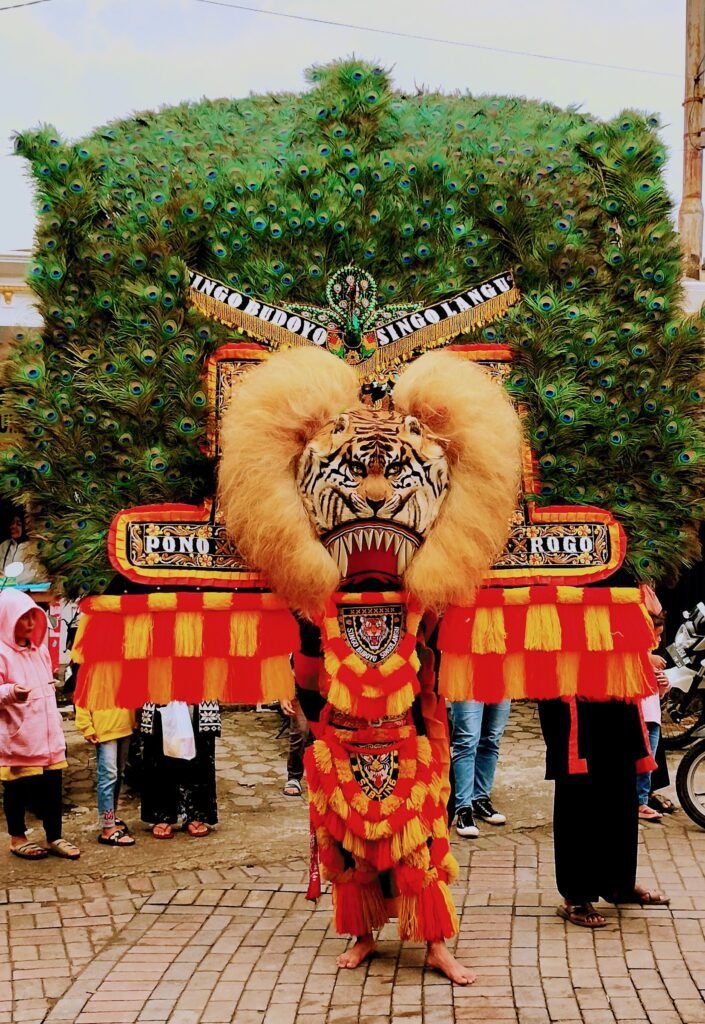
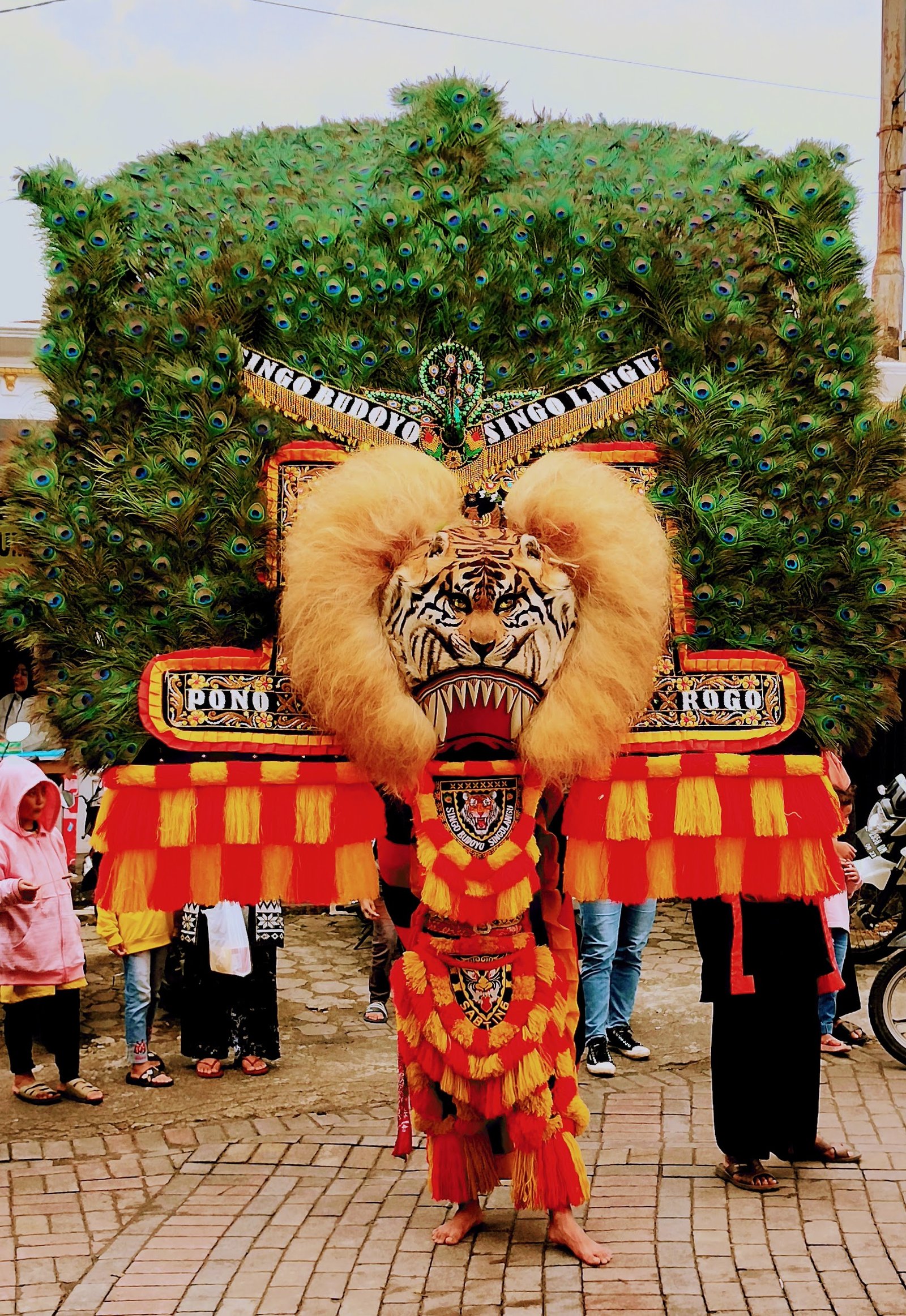
With this in mind, what should the viewer expect? In short, a lion-headed dancer, resplendent in a giant dadak merak mask. The lion has an enormous head made of wood, bamboo and rattan, which makes up the caplokan element of the enormous mask. But it does not stop there. The mask’s frame extends into a giant spread of peacock feathers that rest atop the lord of the plains. These feathers exceed in size even the head of the mighty lion.
The beast’s name is Singo Barong, and it leads a vibrant ensemble in a series of impassioned performances. Many agree that Singo Barong is the vivid heart of Reog Ponorogo. He is a mythical creature and the enemy of King Klono Sewandono, who, lovestruck, has set out on a journey to propose to the beautiful Songgolangit.
The appearance is nothing less than a big fan, flanked on either side by a velvet-embroidered krakap, upon which one may find written the identity of the Reog group.
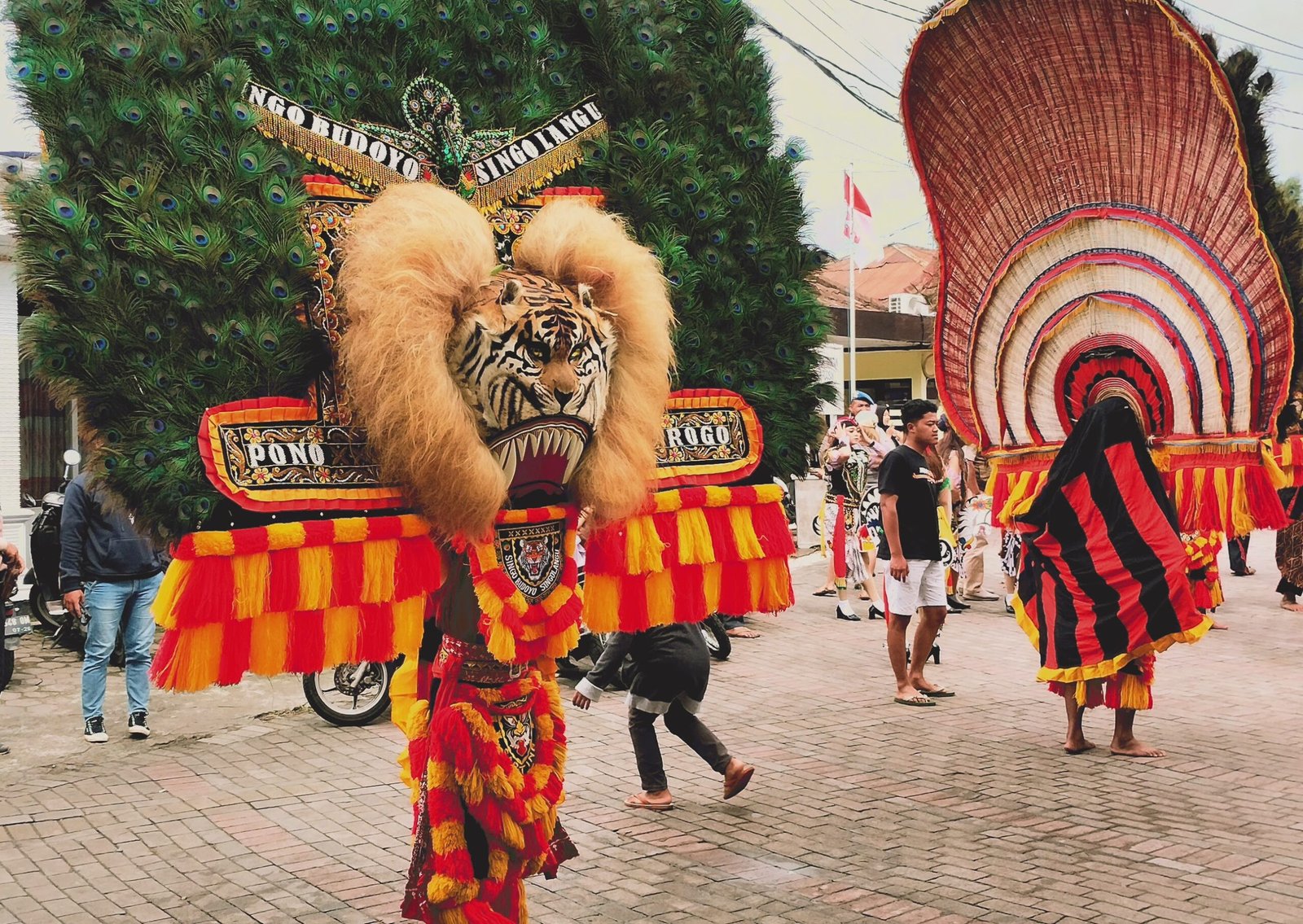
Invariably, the focus flocks to Singo Barong’s outsized head, which spans 2.5 metres. It can weigh over 80 lb and is the world’s largest wearable mask. The dancer, known as a warok, bites down on a concealed cokotan wooden bar to carry the striking and graceful mask. Such power, aided by tali straps that fasten the mask to the warok’s head and shoulders, indicates the huge, bordering on supernatural, strength required to wield the lion’s head. The warok leads the dance and acts as the master of ceremonies.
Shows of strength in Reog Ponorogo
But this burden does not wear down Singo Barong. Indeed, lions rarely show weakness, and Singo Barong gracefully wields his burden. He has the strength to hold the weight of an entire tradition, and his supporting cast makes no less of an impression.
Notable players include the proud and pompous Sewandono, the King of Ponorogo, and the young patih Bijang Ganong, who wears the red mask of a giant. He has a long nose, bulging eyes and thick black hair, and his role often requires two people to perform acrobatic feats in a trance-like state.
Read More: Lawang Sewu: Echoes of Atrocity in Semarang
Equally striking are the jathil, riders of woven bamboo horses. Their effete look satirises the Majapahit cavalry who served Kertabhumi Bhre (who some equated to Brawijaya V), the last king of the Majapahit empire, and whose manliness, some believed, had become diluted. Today’s dance tends to feature female performers in this role, who took over from the gemblak, a teenage boy in vibrant colours.
Reog weaves a historical tale. It follows Klono Sewandono as he heads to Kediri to woo Songgolangit. On his way, he encounters a vicious creature in the forest: Singo Barong.
Arch glance
The dance then gathers pace, mocking the bumbling Majapahit rulers of the empire’s last days. Singo Barong embodies Majapahit’s king and the peacock crown, the queen. She sits above the ruler, indicating who held true control behind the scenes.
For some, the roots of Reog took seed in this power dynamic. Another tale centres upon Ki Ageng Kutu, a fifteenth-century Majapahit courtier in the court of Kertabhumi Bhre. By then, the empire had fallen into decadence and corruption, plagued by incompetent rule.
Kutu, noting the empire’s oncoming demise, left the court and found his way to Ponorogo. Hoping to rekindle Majapahit’s former glory, he set up a school to teach mysticism and martial arts.
These strands soon linked into a new form of dance: Reog Ponorogo. Kutu sought to gain support against the decrepit rulers. He succeeded, and the dance soon became one with the city’s currents.
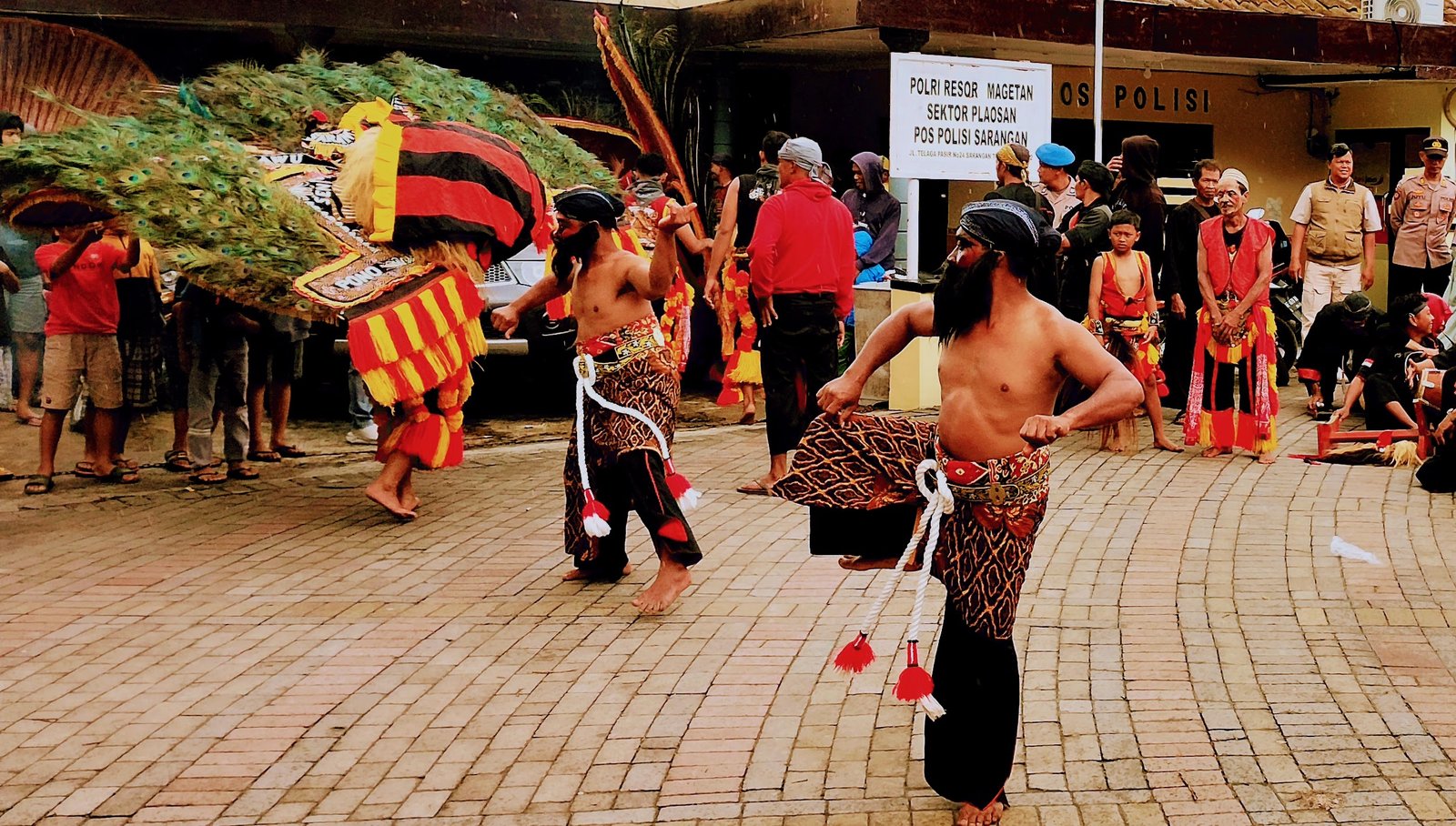
Reog, then, became the dance of rebellion. Enraged by the show of dissent that undermined his authority, Kertabhumi Bhre sent an army to smash Ki Ageng Kutu and his followers. A blow was struck; the school fell, but Reog had come to life, and each new performance breathed further life into its veins.
The dance had clamped itself to Ponorogo, and no amount of force could remove it. For how can one dictate a current or control the birth of wind?
Reog signifies a cultural shift
Thus, Reog gained strength as its practitioners perfected their art away from prying eyes. So popular had the dance become that the King could only watch on as it grew and grew. Soon enough, the people accepted Reog as the dance of Ponorogo. Its stature swelled with the introduction of new plots and characters drawn from the regency’s folklore.
Read More: Rooted in Loss: The Bridal Tree of Salatiga.
Ponorogo is Reog as Reog is Ponorogo; the identity of one takes strength from the other and reciprocates in kind. Singo Barong’s head appears everywhere, from statues to advertisements, as do the other players. The people of Ponorogo are fiercely proud of their heritage and take pride that their home gave form to Reog.
This passion translates into vigour and the noise from which Reog derived its name. Each performance comprises a trio of dances with three sequences involving troupes of up to 35 people. The giant Bujang Ganong opens proceedings before the Jathil take the baton and perform the Jaran Kepang dance.
And finally, all the performers come together for the final sequence, led by the warok. The dance culminates in a tremendous feat of strength as Singo Barong picks up one of the Jathil and carries them atop his mask. All the while, a traditional ensemble, comprising angklung, gedang, gong, kenong and saron amongst others, adds an insistent, reedy urgency to the movements.
Tradition dictates that the Reog dancers perform in a trance in line with the Javanese religious tradition, which looks outward and, by way of rituals and practices, exemplifies the search for harmony, peace of mind and the ties that bind communities as one.
Ponorogo: Things to know
Where to stay
- For the budget-conscious who want to stay close to the alun-alun, consider somewhere like Han Gang Syariah (approx. £10 / 240,000 IDR per night).
- This is Syariah-compliant accommodation that caters mainly for Muslim guests, meaning non-married couples would have to stay in different rooms; the same would apply to same-sex couples regardless of their marital status. Unattached travel buddies looking to split costs by sharing a room might also find things a bit complicated: same-sex travellers can share rooms, but male and female companions can’t
- In all cases, it’s best to avoid PDAs, or public displays of affection, in order to respect the prevailing culture and avoid potentially awkward scrutiny
Getting there and away
- Ponorogo Bus Terminal / Terminal Seloaji is a busy hub and goes to many major points in Java: Jakarta, Surabaya, Surakarta / Solo, Bogor, Bandung and so on. Presumably Semarang and Yogyakarta too, but you’d have to check. Places like Pacitan, Madiun, Ngawi, Blitar and the lakes of Sarangan and Ngebel are also served. Destinations all marked clearly
- By way of reference, EitM took a public bus from Solo’s Tirtonadi bus terminal. The journey lasted about 3 and a half hours and cost 50,000IDR (prices subject to change]. It was just after Liverpool beat Manchester United 7-0 in 2023, and the bus conductor – a staunch United fan – was decidedly not happy. EitM, being Liverpool fans, failed totally to stifle our laughter, and a vague cloud of resentment, directed from conductor to passenger, built up as the journey progressed
What to eat
- Ponorogo is home of its own variant of chicken sate. Sate Ponorogo comprises long, filleted slices of chicken, which are then marinated in spices and sweet soy sauce. The slices are then grilled over charcoal and served with the usual goodies: peanut sauce, chillies, lime juice and rice or ketupat / lontong rice cakes. It’s uniformly delicious, with many vendors dotted throughout town; head for Gang Sate / Jl. Lawu
Discover more from Eye in the Middle
Subscribe to get the latest posts sent to your email.