This page has affiliate links. If you click and buy something, EitM might earn a small commission, at no extra cost to you, the reader. As always, thanks for reading.
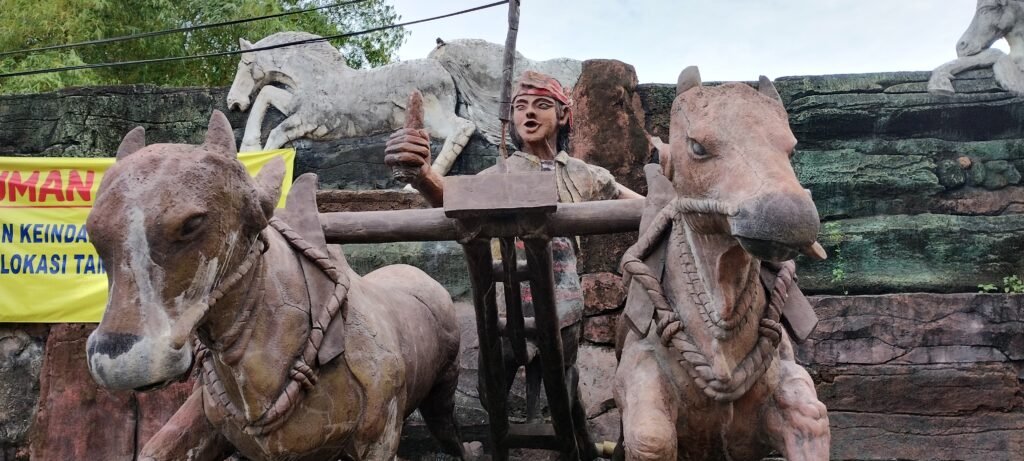
Pulau Garam: Unravelling the Strands of Madura Island
There exists on the northeast coast of Java an arid island by the name of Madura, or Pulau Garam. It is a big, dry place that ranks among the largest and most interesting regions in that part of Indonesia. But despite its size, rich history and thriving culture, Madura as an international tourist attraction nestles in a cloud of vague obscurity, as though the name itself conjures up a fog that dissipates only when one stops thinking of Madura.
It is strange that so many people could ignore such a colossal body. Madura juts out of mainland Java like the tooth of an apex predator. The island’s aggressive, rugged shape is hard to miss and suggests, at least when viewed from above, a huge beast cut loose from the moorings of East Java. This spirit of flight, though, seems to work too well. Few foreign visitors stay on the island, or even talk of it. The result is a corresponding lack of algorithmic clout and engagement that pushes Madura further away from the forefront of these same people’s minds.

Pulau Garam and Majapahit
History shows that Madura played a key role in the growth of Indonesia. A focused gaze on Java in 1292, for example, may land on Raden Wijaya, a scion of the Rajasa dynasty.
Having escaped the clutches of Jayakatwang’s rebellious Kediri kingdom, Wijaya ended up on Pulau Garam, in Sumenep. There, he looked to form a new kingdom with the aid of that region’s governor, Arya Wiraraja. The pair planned to defeat the Kediri rebels and the Mongol hordes who had invaded Java.
This game of political intrigue worked. In 1293, spirited fighting and poor weather forced the invaders to flee. The rebels fared no better, smashed to pieces on the battlefield. And so, Wijaya became the founder and first monarch of Majapahit.
This Hindu-Buddhist empire would become one of Southeast Asia’s most powerful kingdoms. Many have deemed Majapahit the precursor of modern Indonesia in how it unified the archipelago. The kingdom’s red and white colours even inspired Indonesia’s national flag.
Read More: Lion’s Roar: Reog Ponorogo and the Dance of Resistance
Pulau Garam? Don’t you mean…?
But past influence does not mean current sway. For some, Madura hides in plain sight. Closer checks show a place with the uncanny ability to deflect attention away from itself. The island rarely crops on search engine rankings, and there is little English-language content to speak of.
The uninitiated, who may not know of the island, simply assume that any references to it are mistakes. They might then assume that the speaker must mean somewhere else. From the other perspective, perhaps Madura fiercely protects its identity, shielding the island from potentially harmful or corrupting outside influences.
Rarely does Madura haunt any kind of ‘must-visit’ or ‘most underrated places in Indonesia’ list. Instead, a strange kind of farce arises when people discuss the go-to places in East Java. They mention acidic Ijen, praise iconic Bromo, marvel at colourful Malang and so on. But they do not even note the giant land across the Suramadu Bridge from Surabaya.
One possible cause for such an oversight is that the very idea of Madura proves so frail that it evaporates upon exposure to fresh air. A second scenario seems much more likely, wherein an army of playful mirrors patrols the coastline. Whenever they sense a newcomer looking in the island’s direction from places like Probolinggo and Karagajar, they plant themselves in the ground and cast a reflection back to the mainland. The viewer, squinting, catches a glimpse of something they already recognise and, passing interest sated, diverts their gaze elsewhere, away from Madura.
In the real world, however, the answer is much more obvious: logistics. If a holidaymaker has, say, two weeks in East Java, it stands to reason that they could easily stay on the mainland. Moreso, they would have an extremely satisfying and stimulating time. They could head ‘twixt volcano and lake, Batu and Tumpak Sewu Waterfall, surf at G-Land and tour Majapahit sites at Trowluan. Enigmatic Madura would barely warrant a second glance. The island is just out of the way enough to relegate it to the ‘next time’ portion of people’s itineraries, where it stays in perpetuity.
No-thing
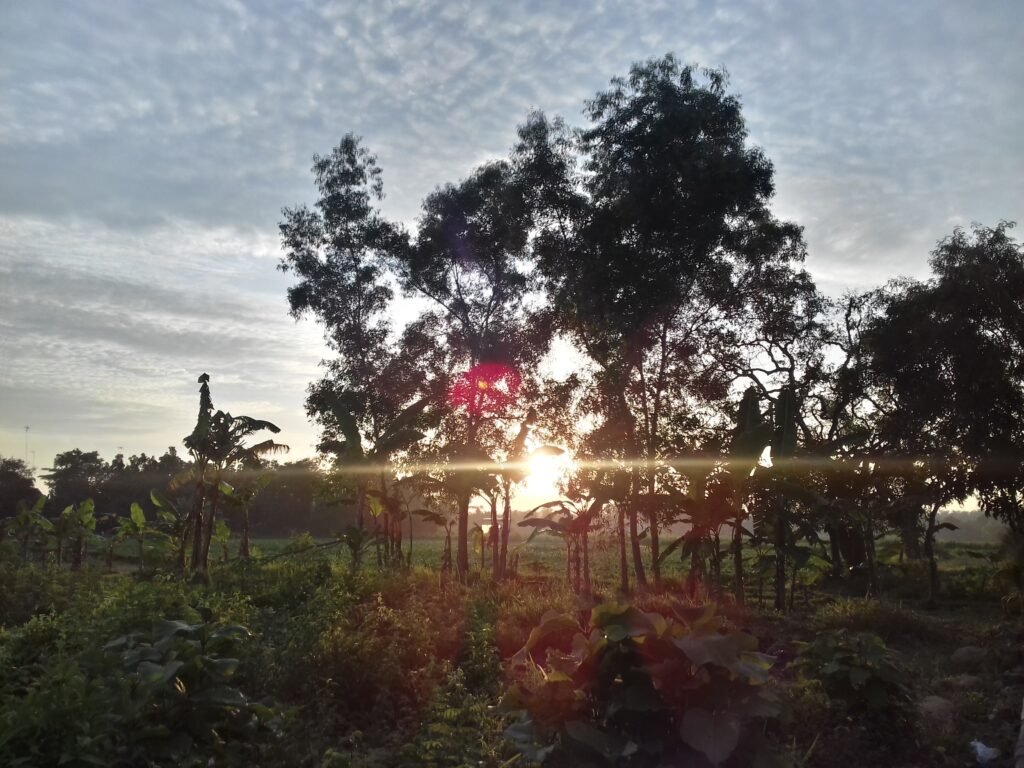
The reason is simple. Pulau Garam, for all its intrigue, warmth and vibrant culture, doesn’t have a major hook. There is no brooding volcano, giant waterfall, or divine stretch of beach to entice the international crowd onto the island.
Madura’s many charms work on subtle levels and require a person’s physical presence to discover them. A passing chat on the streets of Pamekasan, for example, may well lead to other things, like a steaming bowl of Soto Madura, a visit to the bull races or a pencak silat demonstration.
But if a potential visitor has already swerved the island, citing a lack of awareness about the place, they’ll never know of these vibrant, joyous occasions. Consensus has already consigned Madura to the periphery. There, its depths go unappreciated and unseen by the kind of tourist who might otherwise find much to cherish there. Such is the ridiculous echo chamber that swirls around Pulau Garam.
Lack of awareness
It would come as no shock to find that Madura props up a list based on phonetics. Research has shown (Editor: No, it hasn’t) that when asked to name places that sound a bit alike, many people defer to volcanic, beautiful Portuguese Madeira.
Many respondents then tend to mention autonomous Extremadura in Spain, which enjoys a similar kind of cultural independence to Madura. Or perhaps they reference the Indian city of Madurai (formerly Madura) in Tamil Nadu.
The world of content and engagement rarely confuses these places for Madura in Java. In fact, the misunderstanding tends to work in the opposite direction. AI seems to agree. A slight spelling mistake of ‘Madura’ on a search engine often autocorrects the word to ‘Madeira’. Only then, when all other places are exhausted, does Madura call for a mention. But even then, somebody might well ask: ‘Don’t you mean that place in India?’
But maybe Pulau Garam doesn’t seek that type of validation. The island claims a size of 4.43K km², not too dissimilar to nearby Bali, hidden behind the rump of East Java. But the distant Javanese cousin merits only a fraction of the interest that goes Bali’s way.
What’s the point of Canggu? Does anyone know?
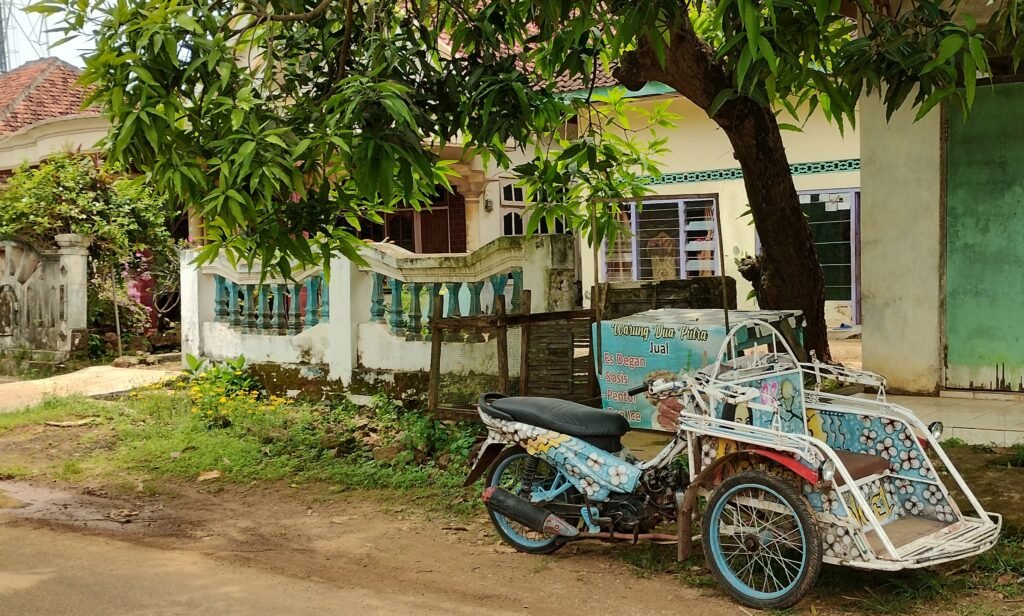
A recent update of the world’s most well-known travel resource (Editor: Too kind…) dedicated tens of pages to the Balinese village of Canggu and its surrounding areas. In contrast, somebody decided that the whole of Madura merited only a page and a half of coverage.
But such a gulf may serve a purpose. Madura is an Islamic island with a conservative, traditional mindset. Its people may have noticed the surface noise generated by places like Canggu, Ubud, Uluwatu, Bingin, Pererenan, Kedungu, and decided that the soulless overdevelopment, massive influx of visitors, loss of green space and general dilution of culture was not for them.
Consequently, a visitor to Pulau Garam will note the total lack of international-focused ‘scenes’ that permeate other, more well-known places further east: YouTubers; Instagrammers; influencers; digital nomads; surfers; skaters; yoga heads; food vloggers who like to film themselves eating and talking. So, too, is there an absence of foreign entrepreneurs and property developers who buy up land and strip it of its soul by labelling it an investment opportunity. Not to mention the lack of crypto people and those weird Ponzi cults that hide behind the mask of high-ticket affiliate marketing.
Read More: Unique Look: The Tower and the Mosque of Kudus
Madura and migration
One may ask with all fairness if Madura’s privacy stems from some deep-rooted resistance to outside influences. History shows that millions of people from the island – an ethnic group known as Orang Madura, Tijang Madura or Wong Madura – migrated to other parts of the archipelago, such as Java, Sumatra and Kalimantan.
But in some of these places, ethnic tension arose between the newcomers and the inhabitants. In particular, the early 2000s clashes with the Dayaks of Kalimantan proved violent and deadly.
Thus, an outsider may notice a mutual dislike between some Wong Madura and people in other parts of Indonesia. There is a tendency amongst some Javanese, for example, to reductively call people from Madura ‘kasar,’ or ‘unrefined’, and strip away the depth and complexity of their home.
Anecdotal evidence from Surabaya, a place with many Madurese migrants, indicates an equally clear clash of cultural boundaries. Some on the mainland have voiced concerns over a lack of business and social etiquette shown by the newcomers from Pulau Garam. Others have cited acts of aggression as a reason for their wariness towards the migrants. EitM once took a taxi in Surabaya. We had recently returned from Sumenep, very much excited by the place. The driver, upon learning where we had just come from, became instantly defensive and wary. The man shook his head and tutted. He wouldn’t explain why, but the sudden change in his mood suggested a previous run-in with a Madurese body.
Equally, it’s best to also consider the transition from the quiet calm of Madura to the chaos of a Javanese metropolis. The stimulation can be jarring. It requires an extraordinary amount of recalibration to a busier, noisier pace of life. The two parties can take time adapting to each other’s rhythms. And while this happens, friction between the direct Madurese and the entrenched protocol of the big city can easily manifest in real-world tension.
Trade on Pulau Garam
Many foreign visitors will never see such tension. The Madurese, like most, rarely share their problems with the uninvolved. Instead, newcomers may note the prevalence of physical, hands-on trades. They will also note that the island’s dry climate does not lend itself to the wet paddy fields found across the rest of the archipelago.
Many Madurese people work as farmers, traders and producers of livestock, often employing a Celurit, or Sabit, sickle. This agricultural tool has a distinct crescent-shaped blade and a long handle. Alongside its designated purpose, practitioners of Pencak Silat employ the Celurit in their martial art.
Madura has a strong bond with the sickle. So much so that it has a strong link with Madurese culture. In fact, it does so as much as the loose, baggy clothing adorned with red and white stripes that honour Madurese freedom fighters like Pak Sakera.
The Madurese have also forged a reputation as fine sailors and fisherfolk. An observer will note the ease with which they use nets, bagan platforms and traditional boats, such as the eyebrow-shaped lis-alis, to catch their harvest.

Salt Island
Less trouble exists in the soil. For, although Madura’s dry earth does not lend itself to cultivating food crops, tobacco thrives in the island’s ground.
The island is a prime producer of this plant, making Madura an integral player in the domestic kretek, or clove cigarette, market. By providing the tobacco that binds the blend together, the essence of Pulau Garam swirls subliminally in the sweet, crackling smoke that is rarely far from reach in Indonesia.
Madura’s salt production and export also ranks as one of, if not the, largest in Indonesia. The importance and renown of Madurese salt registers as an enormous form of clout. People honour this type of farming so much that Madura is sometimes called ‘Pulau Garam,’ or ‘Salt Island.’
Those who visit the villages of Pinggir Papas, Karang Anyar and Kebundadap in Sumenep district may have the chance to see the sacred nyadar festival and witness this importance for themselves.
Here, participants gather food offerings in a red panjhang bamboo basket and collect seven kinds of flowers. These they gather to honour figureheads like Sheikh Anggasuto, who, with God’s will, introduced salt farming to Madura. The parties then drink water and smear lalongsoran powder on their bodies. Finally, they eat the offerings and pray to Allah to ensure the salt farming industry’s continued health.
Read More: Deathless Light: Wisata Api Abadi in Pamekasan, Madura
Beneath the surface
A forcefield, apparently powered by a strong sense of self, seems to surround Madura. Evidence, drawn from social media chatter, suggests that the field has a dampening effect that dilutes interest in the island. Consequently, people who’ve never been to Pulau Garam tend to add a caveat when they discuss the place. ‘You can do such-and-such a thing on Madura,’ they may say. ‘But apart from that, expect to find very little to pass your time.’ Remarkably, even seasoned visitors to the archipelago sometimes adopt this attitude.
This disconnect may stem from the fact that few people speak English, the language of tourism, on Salt Island. Thus, many things, otherwise welcoming and inclusive, hide behind an air of disconnect.
Add to this gap sometimes cramped public transport, the lack of a codified tourist infrastructure and a mood of blunt honesty, and it becomes clear that outsiders receive few concessions. But in this friction, many receive a touch of clarity, a glimpse of how things work there.
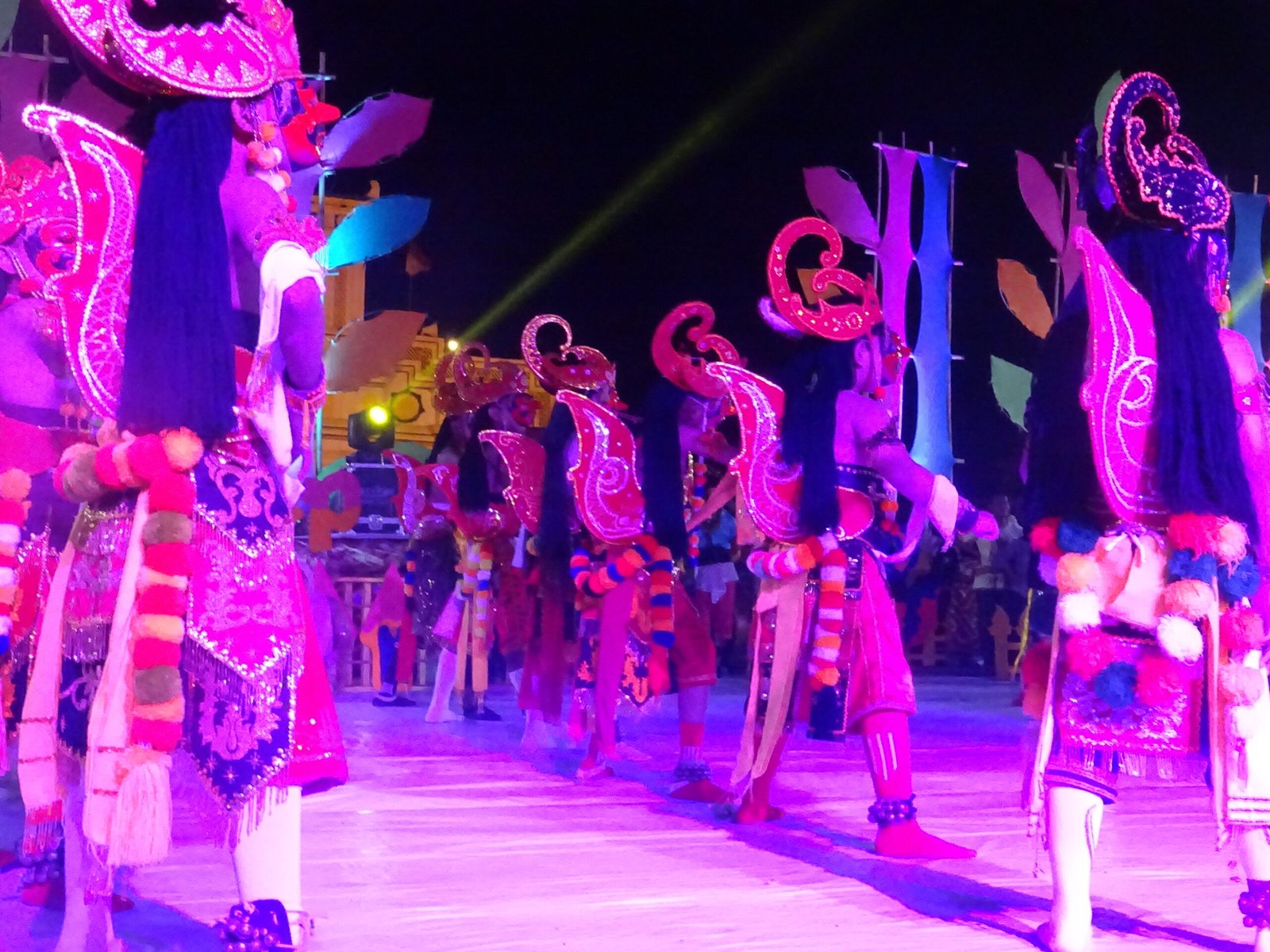
Traditional heritage on Pulau Garam
Alcohol is not widely available on Madura, a staunchly Islamic island. Mostly, it seems that if people fancy a tipple, they have to rely on a friend of a friend of a friend to acquire the goods. Even then, the trade has to happen away from prying eyes, to avoid upsetting the sensibilities of a dry island. But in our experience, few people have sufficient devotion to Bintang or Arak that they would wait hours, if not days, just to savour some. Instead, many people who otherwise drink simply choose to go without on Salt Island.
All of this unfamiliarity makes the island such an endearing destination. Each visit feels, from a holidaymaking point of view, like a trip into the unknown.
A cramped bus ride across Madura, for instance, often involves unscripted, unexpected moments. EitM once took a bus from Bangkalan to Sumenep. It was a stifling hot day, and the bus had neither air con nor decent suspension. We watched as a young bus passenger, bouncing like the rest of us, downed a carton of chocolate milk. And then we winced as the youngster promptly threw it back up again. Partly, this reaction stemmed from self-preservation. Being jammed in the bus staircase, there was no escape as the vomit oozed, slowly but relentlessly, towards us. We forget how the scene played out, but have had an aversion to Ultra Milk ever since.
Once the visitor has settled, many Madurese people greet them with a touch of friendly shock. It seems that the visitor is that rare breed of people outside of Indonesia who knows of Salt Island. Even rarer, they have actually made the time to go there. After all, a person does not end up on the island by mistake. Few flights reach Trunojoyo Airport in Sumenep, except for those on official business, and clearly marked buses leave from Bungurasih terminal in Surabaya.
It would require an exceptional turn of events for someone to trip, unnoticed, onto a bus. It would be equally absurd if they were then ignored by the ticket collector or driver all the way to Madura. ‘Where? Don’t you mean Madeira? In the Azores?’ an all-knowing voice, rich in inflection, asks off-stage.

Pulau Garam’s information network
In other words, a person must make the conscious decision to visit Pulau Garam. Once there, they may find that many islanders abide by the Islamic belief that a guest is a gift from God, or Hadiyat Allah. This notion manifests itself in a warm, genuine and uncynical welcome that some may find overwhelming.
Those invited to a family home for companionship have told of receiving plate upon plate of food. They eat it under the enthusiastic gaze of all present, who ensure that the visitor has had their fill. Nobody eats before the guest has had their fill.
One foreign visitor to Sampang shared a time when, trying to walk 100 metres down the road to buy a lighter, a trip of no more than five minutes took nearly two hours. The man could not pass a building without the residents rushing out to shepherd him into their homes for food, coffee and a hang.
This happened many times, and the visitor has since reported feelings of guilt. After eating five full meals in quick succession, he instinctively declined the kind offer of one more in the sixth house.
But if a gift is offered, one should accept. Thus, the guest felt a bit sheepish for denying his hosts the chance to fulfil their roles as dutiful Muslims. All present did at least have a lengthy, friendly chat, and many photos were taken in a sign of comradeship. In his defence, the guest also expressed gladness for avoiding the danger of exploding, through overconsumption, in the unsuspecting host’s front room.
Views of outsiders
The frequencies on Madura often run beyond what the eye can see. A prevalent underground network of information charges through the island, and comes in many forms: WhatsApp, text, verbal updates.
Since Madura receives so few outside visitors, an unfamiliar person can spark interest. This means the same outsider cannot hope to blend in. Community guardians will note their presence and share their movements, usually as nothing more than a precaution, to ensure the fresh face is OK and not causing any trouble.

A few years ago, a foreign traveller encountered this network firsthand. He had made friends in Sumenep and thought nothing of it. He soon noticed, though, the lengths of Madurese perception. On one occasion, the friends, unprompted, shared what they knew of the traveller’s day. They described where he went, and even the clothes he’d worn. And all of this based solely on WhatsApp chatter charting his movements.
The friends meant no harm. Instead, it showed the traveller’s slow absorption into Sumenep’s rhythm of life. In the same way that a member of a community knows small bits of its members’ lives, the traveller became, however briefly, an object of interest and a part of Sumenep’s gossip framework.
This reach seemingly extends between places on Madura. A town boundary, for instance, does not inhibit the network’s movement. The next day, this same traveller, having left Sumenep, went due west to Pamekasan. There, a stranger approached him , wielding a ringing phone and indicating that the traveller should answer it.
The traveller did so, only to find their friend from Sumenep on the line. The friend spoke with a decisive knowingness, as if they had expected to talk to the traveller all along. But since the traveller had not told anyone of his movements, this meeting, clearly not by chance, still came as a surprise and showed the strong pulse of Madura’s digital grapevine.
But what other things can a visitor expect on Pulau Garam? Tune in for Part 2 to find out about (some of) Madura’s myriad sights, sounds, smells and tastes. The next bit’ll probably be longer than this one, heads-up.
[2025 update: A few bits edited, streamlined and reworded to remove some of the smugger and shitter phrasing. It’s still not a great article, and it’s nowhere near definitive. Hopefully, though, it can contribute to a wider dialogue about Madura.]
Booking resources
Continue Reading: EitM’s [Very] Vague Guides
Discover more from Eye in the Middle
Subscribe to get the latest posts sent to your email.