This page has affiliate links. If you click and buy something, EitM might earn a small commission, at no extra cost to you, the reader. As always, thanks for reading.

Manado City: (Very) Vague Guide to The Hub of Minahasa Tradition
Manado City is the capital of North Sulawesi which, thanks to its marine biodiversity, rich culture and religious harmony, is the gateway to one of Indonesia’s most vibrant regions.
The second-largest city in Sulawesi, outsized only by Makassar, Manado has had many names. In days of yore, the Spanish called the city Manados, while the Portuguese knew it as Moradores or Manada, or ‘herd of islands’. Meanwhile, the Dutch named the place Mandadorezen or Manado’s Gebied. Like all roads that lead to Rome, the many names claimed by Manado all point in the same direction, and with each use, the speaker conveys a clear image of sloping hills, green mountain ranges and, farther out, volcanic peaks at rest in the Sulawesi Sea.
From above Manado City has a vaguely crescent shape. Sometimes, visitors who stand on the edge of the curve, perhaps on the sand near Taman Wisata Karangria, become lost in thought. Usually, this occurs because the depths of the Celebes Sea hypnotise them with its fathoms-deep shades of blue. But these same people, having walked in a daze down the coast, retain enough critical faculty to recognise, from their new spot on the black sand Malalayang Beach, a trio of islands. Namely, Bunaken, old Manado Tua and Siladen.
The wily visitor or new arrival at Manado airport, though, does not get ahead of themselves. They have not yet left dry land. Instead, those who stay in Manado and wander the streets may learn a thing or two of interest. For instance, Manado’s anniversary falls on July 14. The city, states the records, has existed since 1623. And unlike most places in Indonesia, Christianity ranks as the main form of belief.
Manado City is the capital of North Sulawesi, a cultural centre for the Minahasa people, who are indigenous to the regionIn times gone by, it was a stronghold for Dutch, Spanish and Portuguese colonialists. Those with an eye for business will also know that merchants in Manado prospered thanks to the spice trade. The city enjoys a strategic closeness to the Banda Islands, aka the Spice Islands, once the world’s foremost supplier of mace and nutmeg. Many traders stopped off at Manado during trade expeditions to this fertile corner of Maluku.
Read More: Heritage Smoke: The Kretek Museum of Kudus
[Brief] History of Manado City
History shows that the Europeans ruled Manado for a long time. But before these outsiders arrived in North Sulawesi, the Sultan of Ternate, a ruler from Maluku, claimed power over the region in the late fifteenth and early sixteenth centuries. It was he who introduced Islam to the region during this time. And so things stayed for a while. That is, until the 1520s, when the Portuguese arrived and made the Sultan their vassal. This move gave him, and, by extension, the colonists, control over the Minahasans throughout the mid-sixteenth century.
Further north, colonists from Spain made inroads into the Philippines and became a major colonial power by the late 1500s. From there, the Spanish cast their eyes south to Sulawesi. It was a place of incredibly rich soil, within which they could cultivate fine coffee that they brought over from the Americas.
The early 1600s saw Spain develop Manado as a bustling hub where traders from China could buy this coffee to sell in their own country. However, this course of action did not run smoothly. The Minahasans pushed back against the Spanish, resisting the outsiders’ aggressive push to corner trade and monopolise land.
Mestizo Manado City
Back 1529, Charles V, emperor of Spain, signed the Treaty of Zaragoza. This agreement came about because of the staggering debts incurred by the Spanish from the War of the League of Cognac. For the price of 350,000 ducats [approx. US$5 billion], the treaty legally renounced to Portugal Spain’s claims of territory in the region. It also relinquished Spanish navigation rights over the Spice Islands of the Moluccas.
The Portuguese theoretically gained a foothold in this part of the archipelago. But it seemed that the tendrils of this bureaucracy took their time to settle in Indonesia. The Spanish seemed to ignore the agreement. And so, by the middle of the sixteenth century, they moved to seize control of the region. First, they recruited rival Minahasan tribes from the surrounding hills to help take control of the Portuguese fortress in Amurang.
From this new base, the Spanish outsiders moved northeast. They soon reached Manado, where they established a fort. As the Spanish colonists’ roots settled, a unique Indo-Eurasion Mestizo community flourished in Manado. The Spanish had dug deep into the region and embedded themselves. In 1630, Muntu Untu, the son of Spanish Mestizo, became the first King of Manado.
But the colonists could not hold power indefinitely. The Minahasans, tired of corruption and oppression, wanted rid of Iberian rule. With this goal in mind, leaders such as Supit, Pa’at, and Lontoh parlayed with the Dutch, and entered into a strategic alliance with them.

Strategic port
By now, Manado was a strategic trading port of great value. Rice from the volcanic highlands of Sulawesi, for instance, was a valuable commodity for Europeans vessels heading to the Spice Islands.
Together, the Minahasan forces and their new allies, comprising military assistance from the Dutch East India Company (VOC) based in Ternate, North Molucca, gained the upper hand in Manado in 1655. Together, they drove the Spanish out. The Dutch built their own fortress, named Fort Amsterdam, in 1658, and within a few years, the Portuguese also found themselves expelled from the region, minus a great deal of money and influence.
It did not take long for the Dutch to make their mark. First, the VOC banned Catholic practices introduced by the Portuguese. In Catholicism’s place, the Dutch established Protestantism as the predominant form of religion around Manado. In 1677, the newcomers constructed a place of worship they called Oude Kerk, or Old Church. This edifice still stands in Manado and goes by the name of Gereja Sentrum.
The church laid the foundations of the massive conversion to Protestantism led by nineteenth-century missionaries like Johann Friedrich Riedel and Johann Gottlieb Schwarz. This chain of events saw Christianity become, and remain, the prime religion in Manado and the surrounding Minahasa region.
Stable times in Manado City
For the next couple of centuries, the tides of global power ebbed and flowed. In 1810, the British ship HMS Dover captured Manado City. Two decades later, in 1830, Prince Diponegoro was exiled there following his surrender in the Java War against Dutch colonists.
By 1942, the Japanese had gained control of Manado City as part of their expansion in the region during the Second World War. And after that, political instability once again reared its head. In 1958, the central government took their turn on the power carousel in North Sulawesi. The authorities launched military strikes to quell the rebel Permesta movement, resulting in thousands of casualties.
Stability, though, eventually found its way to Manado City, which was officially named North Sulawesi’s capital in 1962.

How Manado got its name
In Sangir, a language based in the Sangihe archipelago that reaches north from the tip of Sulawesi, the word ‘manaro’ means ‘in the distance’.
Originally, around the thirteenth century, seafarers left the Sangihe Islands and headed south towards North Sulawesi. They landed just off the coast on a volcanic island, which, given its isolation, cultivated in the newcomers an abstract sense of far-off distance. This detachment inspired the island’s name: ‘Manaro’. The seafarers settled on their new island home which, thanks to its jagged edges, served as a natural defence against pirates and invaders.
Generations later, the seafarers migrated once more, this time navigating southeast to the fertile mainland of Sulawesi. There, they could develop a larger, more stable community, and cultivate the region’s healthy volcanic soil.
Having settled ashore, the seafarers brought the name ‘Manaro’ with them. The term underwent a linguistic shift, based on the Minahasa dialect, and morphed into ‘Manado’. The seafarers christened their new city with this name. But they did not forget their roots. They made sure to honour their old volcanic home by naming it Manado Tua, or ‘Old Manado’, in deference to the island’s status as their original settlement.
Torang samua basudara
Many outsiders have noted Manado’s warm hospitality. And even if they don’t, the depth and breadth of the place’s heritage will soon become clear. The sound of gongs alat bambu and other traditional instruments often plays in the air. And if the listener follows this sound, the insistent resonance of which signals a sense of performative devotion, they can find its source in dances like kabasaran, cakalele and maengket.
Minahasans account for the majority of people in Manado, and the Indigenous population are of Tombulu blood. The region, though, features many different groups: Babontehu, Bantik, Borgo, Gorontalo, Mongondow, Sangir, Siau, Talaud and Tionudese. Added to this mix are Sumatran Bataks, Chinese, Javanese, Makassarese from southern Sulawesi and Moluccans, whose roots trace to Maluku. The main language is Bahasa Manado.
In terms of belief, and stemming from the historic efforts of Dutch missionaries, Manado follows a mostly Christian path. So doing, it bucks the trend in Indonesia, where, in many places, Islam claims the most followers. But faith is not limited here. Christians live beside Muslims, as do followers of Buddhism, Confucianism and Hinduism. Judaism is also represented: the Jewish community finds sanctuary in the region, and the Sha’ar Hashamayim Synagogue, in nearby Tondano, is Indonesia’s sole active synagogue.
Faith and harmony in Manado City
Unlike other places in the archipelago, Manado has never suffered a major religious or sectarian conflict. Here, people say, ‘Torang samua basudara’, or ‘We are all family’. This attitude symbolises inter-faith harmony and negates the need to harm someone based on their beliefs.
When other parts of Indonesia, such as Ambon, suffered Muslim-Christian conflict in the early 2000s, Manado City stood firm. Pastors and Imams stood together to defuse attempts to start a holy war in the region. This unity contributed to Manado’s position as a place of renowned harmony and mutual protection. Bukit Kasih, or the Hill of Love, typifies this accord. On this hill outside the city, a Buddhist temple, Catholic and Protestant churches, a mosque, and a Hindu temple sit side-by-side. Their peaceful existence shows that different creeds do not have to drive people apart.

Sam Ratulangi
Those who wander the streets or arrive at Manado’s airport, or even study at the city’s university, may note the name Sam Ratulangi, a National Hero of Indonesia. His likeness appears on statues and busts in Manado and Tondano. And roads across the Minhasa region, in cities like Bitung, Manado, Tomohon and Tondano, bear his name.
Ratulangi was a Minahasan teacher, journalist and politician. He was an important figure of the Indonesian independence movement, which criticised the Dutch colonial powers and foresaw the Japanese invasion in the Second World War. Ratulangi formed part of the group that sanctioned Indonesia’s Constitution and served as the first Governor of Sulawesi. He also gained renown for his humanism, coining the Minahasan phrase ‘Si Tou Timou Tumou To’, or ‘humans live for the sake of others.’ This belief draws parallels with the Minahasan code of Mapalus, wherein people help each other for the sake of doing a nice thing.
Read More: Obscured in Mist: Finding Telaga Sarangan by Mistake
What to do in and around Manado
Manado City offers many ways to pass the time. Those who head northeast for 40-ish miles will find Tangkoko Nature Reserve, which takes its name from a volcano. The reserve protects many endemic species, including tarsiers and macaques. Fears may arise, however, about the cruel reach of nearby hunting and habitat destruction.
North Sulawesi has a tradition of eating wild bushmeat. Near Manado, in places like Tomohon Extreme Market, species like domesticated dogs, yaki macaques, fruit bats, forest rats and boars are sold as delicacies. Some visitors, shocked at the suddenness of their exposure to this stark reality, report trauma at the poor conditions in which these creatures are kept, and the viciousness of their eventual fate.
And Tangkoko itself has suffered from the encroaching grasp of development. Over the years, land around the reserve has been repurposed for agricultural use, to harvest crops like cloves, corn and coconuts. This drive has surrounded the reserve, and left it increasingly isolated. Its inhabitants are cut off from other forest dwellers, instead surrounded by the noisy trappings of human civilisation.

Bitung and Bunaken
Close to Tangkoko is the city of Bitung, from which it is possible to reach the Lembeh Strait, a place favoured the world over for its muck-diving and photogenic waters; the things that live inside this water are just as pretty. Little needs to be said about the island of Bunaken, to the north of Manado, except that the seawalls are steep, its crevices deep and inhabitants varied, while rumours of mermaids, orcas and the machinations of spirits give the island a far-off, bubble-like quality.
Read More: Rooted in Loss: The Bridal Tree of Salatiga
Tomohon
Tomohon, located in the hills and home to a cool, crisp climate, is home a rich tapestry of culture and nature. Keen sightseers will find much to please them around the area’s peaks and valleys.
For many, the twin-volcano Lokon-Empung is the literal and symbolic high point. Rising over the Tondano Plain and about an hour’s walk to the west of the city, visitors can expect a close encounter with some of Indonesia’s most active volcanoes. On a clear day, views reach Manado City to the north.
Lokon’s imposing crater is an arresting sight. Mostly flat and strewn with volcanic rocks, it belches reams of smoke from sulphur-tinged fissures. These cracks only hint at the destructive power beneath. The volcano’s cone, flat and craterless, reaches a height of 1,580 metres. Empung, the younger and smaller of the two, has a crater 400 metres wide and 150 deep. No surprise that the latter is more prone to erupting, which it last did in the eighteenth century.
Mahawu volcano
The ‘other’ major volcano in Tomohon, dormant Mahawu lacks the size of Lokon-Empung but not the awe. This smaller crater, flanked by two pyroclastic cones, allows for fine views of the landscape, some say as far as Pulau Bunaken.
Visitors have reported a floating, supreme calm on Mahawu. Others swear that they could touch the clouds, so close does the peak feel to the sky. Birdwatchers will have much to interest them on the green summit. This part of Sulawesi has many beautiful species, some of them endemic to the region.
Those who look around the verdant volcanic slopes, might be lucky enough to see elusive species like the Scaly-breasted Kingfisher, which often lurks in the undergrowth, or the colourful Sulawesi Pitta. Fruit Doves, many with crowns of vivid feathers, are often seen along the summit’s fruiting trails while at night. And when night falls, the Sulawesi Scops Owl announces its presence with echoing whistles and calls.

Temples and statues in Manado
There are many other interesting things to see. Those with an interest in the fixings of spirituality can visit Ban Hin Kiong, a historical Taoist temple. It is a place of much abundance and many blessings. The temple, Manado’s oldest, has survived renovation and immolation. Perhaps it is a sign that the site lies under the watchful gaze of Shouxing, the God of Longevity.
Equally striking is the Yesus Kase Berkat, or Christ Blessing, statue. This structure dominates the view like the Cristo Rei statue of Dili, Timor-Leste. Perhaps it is possible to equate the size of a monument to the depth of feeling it symbolises. If so, this imposing 50-metre statue, found in Malalayang, shows that faith runs deep and true in Manado. A statue in the heart of the city also immortalises Maria Walanda Maramis. This Indonesian hero advanced women’s rights in the twentieth century.

Cap tikus
Whilst the taste of Manado comes from many fine dishes, not least bubur Manado rice porridge, of lasting note is the notorious cap tikus. Cap tikus translates as ‘rat stamp’, which may have some hidden meaning but seems to have little bearing on the end product. Most consumers will care very little for the drink’s symbolism. This is a sure sign that they have consumed a quantity of this traditional drink distilled from aren, or sugar palm. And then they find that such cares have long since vanished. Cap tikus has a strong taste and an alcohol content of up to 50 per cent, which places it firmly in ‘rocket fuel’ territory.
Small surprise then that one day, the authorities cottoned on that cap tikus represents something of a health risk. Some consumers become ferocious and violent, and others have died from drinking it. Such losses prompted the slogan ‘brenti jo bagate’, emblazoned in stern type on many warning signs in a bid to ward people off the dangers of cap tikus. One may wonder whether the drink inhibits or enlivens the love of singing and karaoke that permeates Manado.
But with every buzz comes a crash. Despite being the main transport hub of North Sulawesi, even Manado has to slow down once in a while and regroup. At dawn, the streetcleaners move across the city. They prepare the roads for the onslaught of traffic, and the whole story soon begins to repeat itself.

Things to know
Accommodation
- RedDoorz at Jalan Babepalar Rike Manado [Jl. Babe Palar; approx. £11 / 255,000 IDR a night for a double room] is fine, but best suited for a night or two only. Decent-sized rooms, cleanish bathrooms [although some people online mentioned cockroaches, grimy mirrors and toilets that require manual flushing with the aid of water and a bucket; the experienced traveller will know what to expect for this price range], close to the bus terminal. Wi-Fi seemed to work OK, if a tad erratic. Food options nearby
- Istanaku Guesthouse [Jl. W.R. Supratman; approx. £16 / 365,000 IDR a night for a double room] is a far better option. Comfy and clean rooms, no reports of cockroaches, close to Pelabuhan Bersehati for boats to Bunaken. Helpful and friendly staff,
Getting around
- The Grab and Gojek apps are both functional, and there are ojek stations, pangkan ojek, scattered around town. Manado’s a noisy city with much traffic, so walking in busy times like rush hour might prove irksome. Malalayang beach is strollable, though, as is the boulevard on Jl. Piere Tendean
Getting there and away
Tomohon
- Buses and shared vans – which, word of warning for the bulkier or taller traveller, can be very cramped – depart regularly from Terminal Karombasan in the south of Manado. It’s about an hour to Tomohon, arriving at Terminal Beriman, and costs approx. 30,000 IDR. We suggest leaving at mid-morning when the traffic is at its lightest
Bunaken
- Public boats depart daily, apart from Sundays, from Dermaga Wisata Kalimas. Travellers can expect to pay 50,000 IDR. Regular visitors speak of a ‘local price’, that presumably is a bit cheaper and applies to known individuals. It won’t apply to pretty much most people, though, so put it out of your head
- Boats depart Manado in the afternoons from 2 pm and Bunaken at 8 am
- Certain ship captains seem to have mastered the power of telepathy and materialisation. One captain we’d never met knew us by name as soon as we arrived at the port. On Bunaken, the same guy would appear from nowhere, say hello and disappear again. All of this, by the way, was very friendly and totally non-intrusive, and further evidence of how perceptive many Indonesians seem to be
Airport / Flights
- Sam Ratulangi Airport – named after an Indonesian educator who stood up to Dutch colonial forces – is 13km, approx. 45 minutes, north-east of Manado. Travellers can use taxis, Grab or Gojek to reach the airport from Manado City, and vice versa, too, from the designated pick-up areas. We used a taxi, which cost 150,000 IDR from one of the taxi counters
- Domestic flights come and go from Jakarta, Surabaya, Denpasar, Makassar, Sorong and Gorontalo
Read Next: Visit Tomohon: North Sulawesi’s Highland Highlight
Continue Reading: EitM’s [Very] Vague Guides
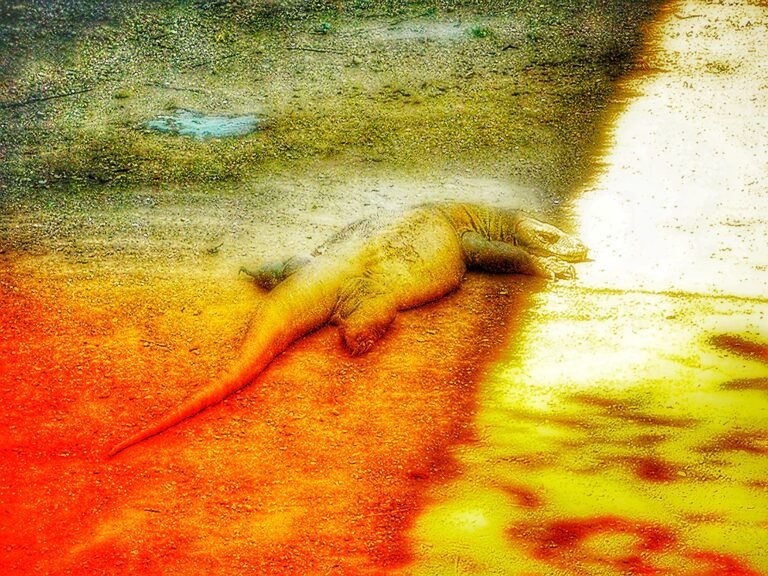
[Editor: You are correct, dear reader, in your assumption that we at EitM are professional-standard photographers.]
Discover more from Eye in the Middle
Subscribe to get the latest posts sent to your email.